Short answer: A whole house system treats water where it enters the property, so every tap, shower and appliance gets the same water. Point-of-use filters treat one outlet. Knowing which problem you have decides which of the two is worth paying for.
What this guide covers
Whole house versus point of use
A whole house system sits on the main line after the meter and treats everything downstream of it.
A point-of-use filter sits under a sink or on a tap and treats only the water leaving that one outlet.
Scale, staining and laundry problems are whole house problems. Drinking-water taste is usually a point-of-use one.
- After the meterwhere a whole house system belongs
- 3-5 dayscorrect softener regeneration interval
- 0.3 mg/Liron level that begins fouling softener resin
- Freeon-site testing before anything is specified
When a whole house system is the right answer
Hardness is the clearest case. Scale forms in the water heater, the dishwasher, the washing machine and the pipework, and none of that is reachable from a kitchen filter.
Iron staining is another, because it marks basins, showers and laundry throughout the property rather than at one tap.
Chlorine taste and smell also justify whole house treatment where the household notices it in the shower as well as the glass.
What a whole house stack contains
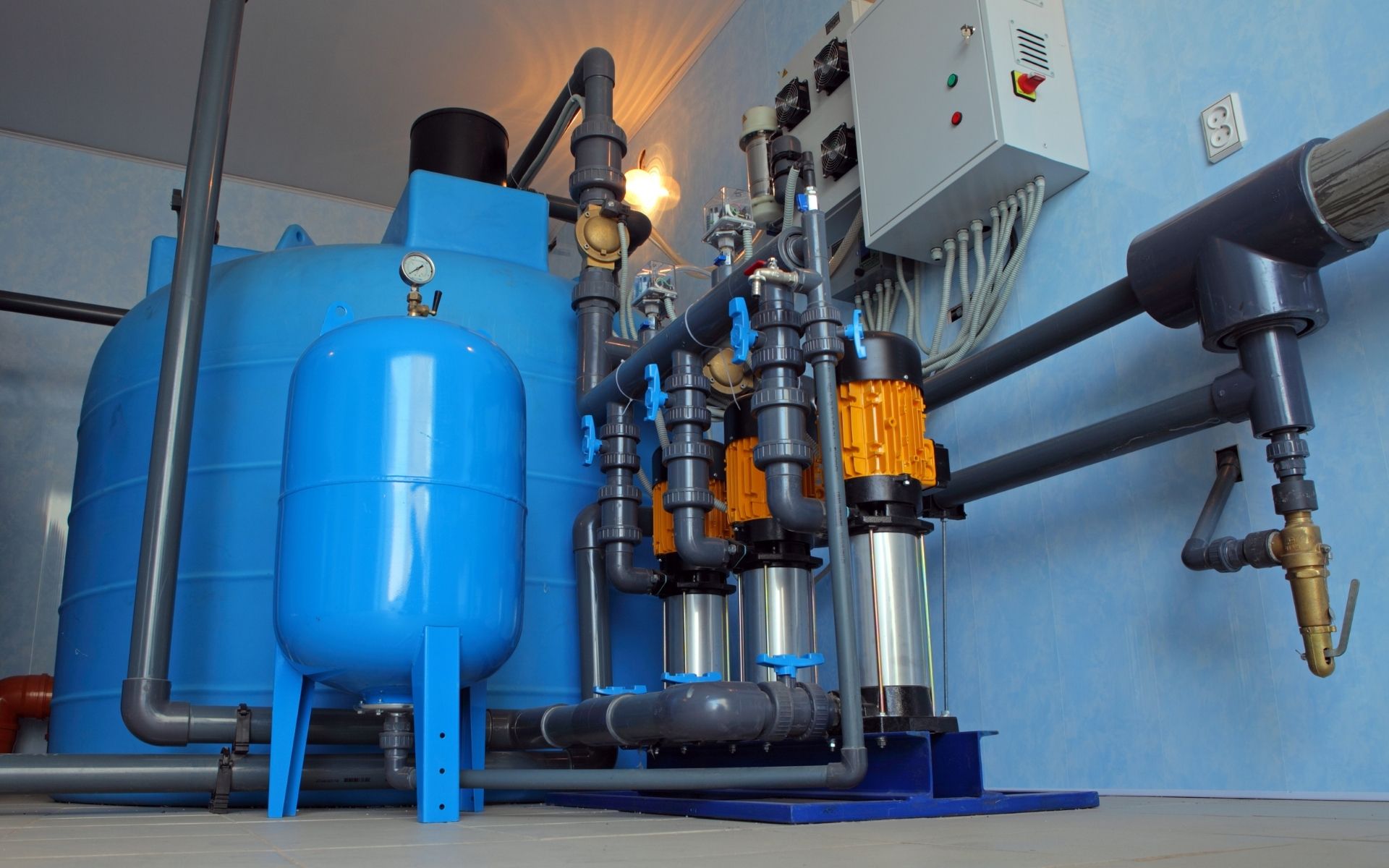
Sediment filtration comes first, catching sand and grit that would otherwise blind everything behind it.
Iron and sulfur removal follows on private wells, because both foul softener resin if they reach it untreated.
Softening comes next, then ultraviolet disinfection where bacteria are present, and a carbon stage for chlorine on city supplies.
- 1TestHardness, iron, chlorine, clarity and pH measured at your tap.
- 2Size for flowCapacity matched to bathrooms and simultaneous demand.
- 3SequenceStages ordered so each one protects the next.
- 4InstallLicensed fitting with bypass, air gap and legal drain.
Sizing for flow, not just capacity
A whole house system has to deliver the flow the property actually uses, or the household notices a pressure drop every time two fixtures run at once.
Bathroom count, simultaneous demand and pipe size all matter, and larger Hill Country properties frequently need more capacity than a catalogue tier assumes.
Softener capacity, separately, comes from household size, daily use and measured grains per gallon, targeting regeneration every three to five days.
| Problem | Whole house | Point of use |
|---|---|---|
| Scale in the water heater | Yes, softening | No |
| Stiff laundry | Yes, softening | No |
| Orange staining in showers | Yes, iron filtration | No |
| Chlorine smell in the shower | Yes, carbon | No |
| Drinking water taste | Optional | Yes, reverse osmosis |
| Nitrate or arsenic | Possible, specific media | Yes, reverse osmosis |
On city water
Public supplies in this region are safe, treated and reported, and still very hard because the water moves through limestone.
A whole house softener plus carbon handles the two common complaints, scale and chlorine, without touching the safety of the supply.
Reverse osmosis is then added at the kitchen tap for households that want the drinking water polished further.

On a private well
Private wells are unregulated, so the specification has to start from a test rather than from an assumption.
The whole house sequence is longer: sediment, iron and sulfur, softening, then ultraviolet, each stage protecting the one behind it.
Putting a softener ahead of iron removal is the most expensive error in the whole house world, and it is the one we correct most often.
Installation and placement
Equipment belongs after the meter and before the water heater, with a bypass so the property can run without it during service.
The drain needs an air gap and a legal discharge point, which is the detail most often improvised on a rushed installation.
Outdoor installations are common here and need protection from heat and the occasional hard freeze, both of which shorten valve life.

What maintenance looks like
Cartridges are changed on a schedule set by your water rather than by the box, and heavy sediment means more frequent changes.
Media beds need periodic checking and eventual replacement, and ultraviolet lamps lose output long before they stop glowing.
We service every major brand, including systems we did not install, and we retest at visits because water chemistry drifts.
Where we work
We cover Boerne, Kerrville, Fredericksburg, New Braunfels, Canyon Lake, Bandera, Bulverde and San Antonio.
Emergency callout runs around the clock, because a leaking or bypassed system is a today problem.
Testing is free and carries no obligation, and a fair share of visits end with us recommending nothing at all.
Frequently asked questions
Do I need a whole house system or just a filter at the sink?
Scale, staining and laundry problems need whole house treatment. Drinking-water taste is usually solved at the tap.
Will a whole house filter soften my water?
No. Filtration improves clarity and taste. Only ion exchange removes calcium and magnesium.
Where is the equipment installed?
On the main line after the meter and before the water heater, with a bypass and a legal drain with an air gap.
Will it reduce my water pressure?
Not if it is sized for your flow. Pressure complaints usually trace back to a unit specified on capacity alone.
Can you service a whole house system another company fitted?
Yes, on every major brand, starting with a water test rather than an assumption.
Book a free whole house water test
We test on site for free across Boerne, Kerrville, Fredericksburg, New Braunfels, Canyon Lake and the wider Hill Country. You get the numbers in writing, with no obligation.
Related reading: water filtration systems, water softeners, reverse osmosis systems, free water testing. See also our complete water treatment systems.
More from this guide: our filtration services, reverse osmosis at home and the signs of hard water.
Sources and further reading: Texas Well Owner Network (Texas A&M AgriLife), EPA national primary drinking water regulations, Texas Water Development Board groundwater data.