Short answer: Filtration services cover everything that removes what you can taste, smell or see in your water, as distinct from softening, which removes hardness. In the Hill Country that usually means chlorine on city supplies and iron, sulfur or sediment on private wells.
What this guide covers
What filtration actually removes
Filtration is a physical and chemical process. Media either traps particles mechanically or adsorbs dissolved compounds onto its surface.
That is why filtration services and softening are not interchangeable. A filter does not remove calcium and magnesium, and a softener does not remove chlorine, sulfur gas or grit.
Most Hill Country households end up with both, because the two solve genuinely different problems.
- 5-8 yrtypical carbon life on city water
- 0.3 mg/Liron level where staining begins
- 10 psipressure drop that signals a due cartridge
- 24/7emergency service across the Hill Country
City water: chlorine and taste
Municipal supplies in San Antonio and the Hill Country towns are disinfected, which is a public health necessity and also the most common complaint we hear about taste.
Whole-house carbon filtration removes chlorine at the point the water enters the property, so it is gone from every tap, not just the kitchen.
There is a second benefit that gets overlooked. Chlorine gradually degrades softener resin, so filtration services fitted ahead of a softener extend its working life.
Well water: a longer list
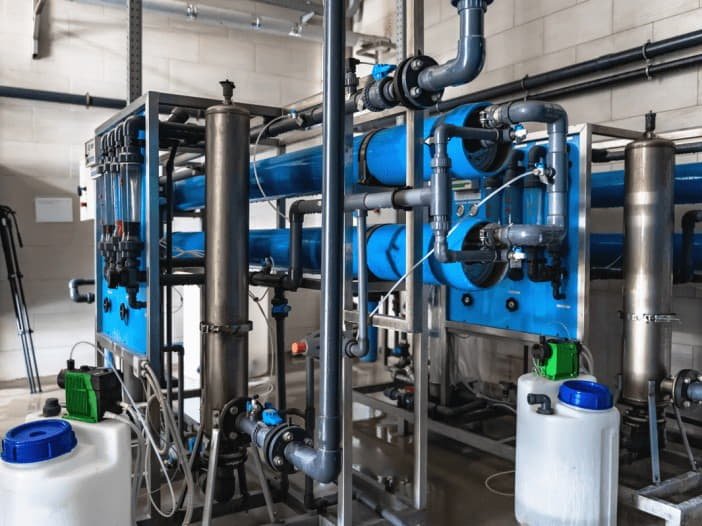
Private wells bring their own catalogue. Iron stains fixtures orange, manganese leaves black specks, hydrogen sulfide smells of rotten eggs, and sediment arrives after heavy rain.
Each of those needs a different medium, which is why filtration services on a well are specified from a test rather than a package.
Order matters as much as media. Sediment first, then iron and sulfur, then softening, then disinfection where bacteria are present.
- 1TestFree on-site analysis of what is actually in the water.
- 2SpecifyMedia matched to each contaminant found, in the right order.
- 3SizeVessels matched to your flow rate and fixture count.
- 4ServiceScheduled media and cartridge changes, any brand.
Matching media to the problem
The media inside the vessel is what does the work, and the wrong choice underperforms quietly rather than failing obviously.
| Problem | What you notice | Filtration media |
|---|---|---|
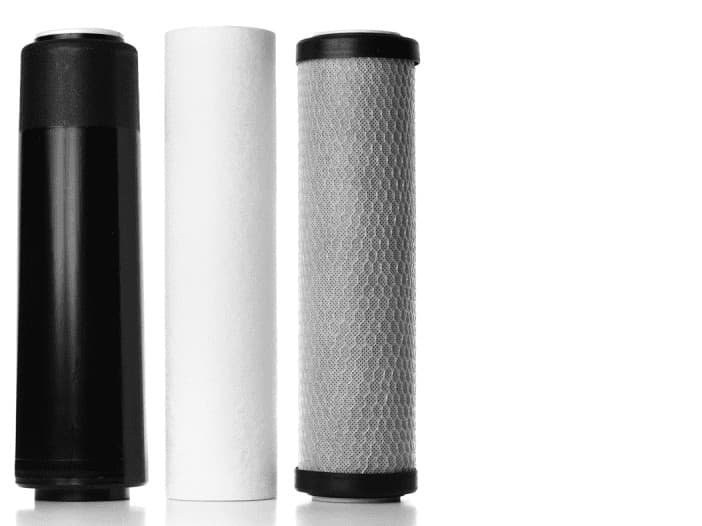
| Chlorine | Pool smell, flat taste | Catalytic or granular carbon |
| Sediment | Grit in aerators, cloudiness | Depth or spin-down pre-filter |
| Iron | Orange staining | Oxidising media, ahead of the softener |
| Manganese | Black specks | Manganese-rated media |
| Hydrogen sulfide | Rotten egg odour | Aeration or catalytic carbon |
| Dissolved solids | Flat drinking water | Reverse osmosis at the tap |
Sizing to flow, not to floor space
Every filter creates some resistance. Filtration services sized to a catalogue rather than your actual flow rate produce the complaint we hear most often, which is a drop in shower pressure.
We size vessels to the pump curve on a well, or to the incoming main on city water, and to how many fixtures run at once.
A house with three bathrooms in simultaneous use needs a different specification from a couple in a two-bed cottage, even on identical water.
Where reverse osmosis fits
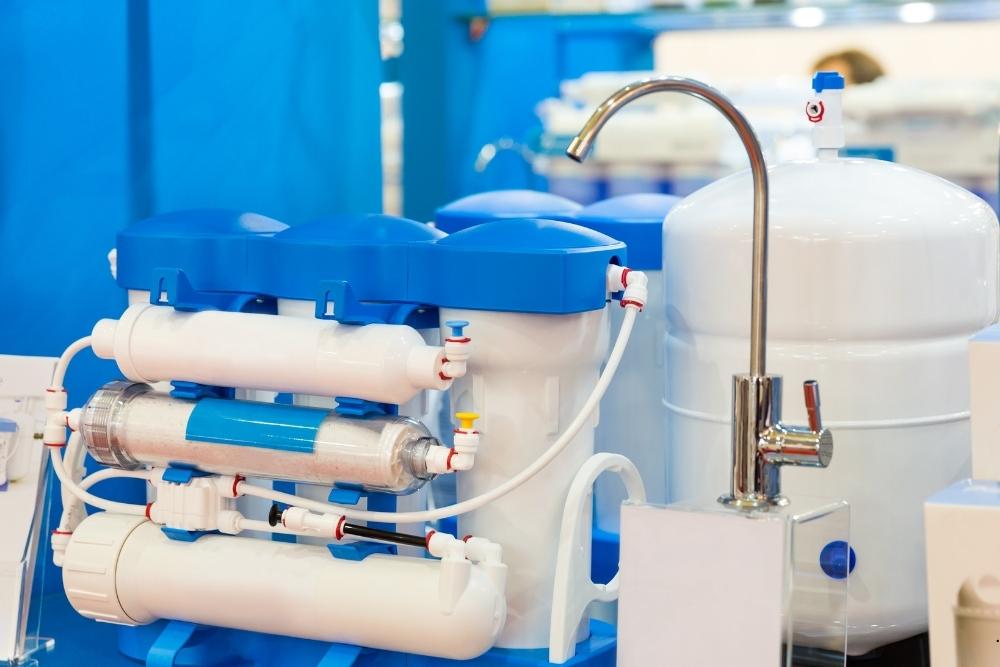
Whole-house filtration improves everything. Reverse osmosis at one tap goes considerably further, stripping dissolved solids that no whole-house filter removes.
It is the most targeted of the filtration services we offer, because it treats the water you actually drink and cook with rather than the water you flush.
On a well it plays a second role as a final barrier for nitrates, which are dissolved and pass straight through mechanical filtration.
Maintenance and what it costs
Carbon is consumed as it works and typically needs replacing every five to eight years on city water. Sediment cartridges run on a schedule set by your water.
Backwashing media beds need a drain connection and flush automatically. They cost more up front and less in handling.
A pressure gauge either side of a filter is the cheapest upgrade you can make. When the difference climbs by about 10 psi, the cartridge is due, and guesswork ends.
Comparing quotes sensibly
Ask what each vessel is rated for and at what flow rate. Vague answers usually mean the design was copied rather than calculated.
Ask what the media is and how often it is replaced, because that is the running cost that separates otherwise similar proposals.
Good filtration services come with the test results attached. If nobody tested your water, nobody knows what the equipment is for.
Servicing what is already there
A great deal of the filtration equipment in this region was installed by companies that no longer trade, which leaves households without support.
We service every major brand, including systems we did not supply, and we will say plainly when re-mediating an existing vessel beats replacing it.
Where a system genuinely is beyond economic repair we say that too, with the numbers to back it.
Frequently asked questions
Do filtration services remove hardness?
No. Hardness is dissolved calcium and magnesium and needs ion exchange. Filtration handles taste, odour, particles and specific contaminants.
Do I need filtration on city water?
Often yes, for chlorine taste and to protect softener resin. It is a comfort and longevity measure rather than a safety one on a municipal supply.
Will filtration fix the rotten egg smell?
Yes, with the right stage. Hydrogen sulfide needs aeration or catalytic carbon; a sediment filter or softener will not touch it.
How often does media need changing?
Carbon five to eight years, sediment cartridges three to twelve months, iron media five to ten years. Your water sets the interval, not the calendar.
Can you service another company system?
Yes. Repair and re-mediation on any brand is a large part of our filtration services.
Find out what your water actually needs
We test on site for free across Boerne, Kerrville, Fredericksburg, New Braunfels, Canyon Lake and the wider Hill Country. You get the numbers in writing, with no obligation.
Related reading: water filtration systems, reverse osmosis, well water filtration, free water testing. See also our complete water treatment systems.
More from this guide: reverse osmosis at home, the signs of hard water and hard water in San Antonio.
Sources and further reading: Texas Well Owner Network (Texas A&M AgriLife), EPA national primary drinking water regulations, Texas Water Development Board groundwater data.