
Most softener companies will quote a house on the city supply all day and go quiet when you say the word well. We have been treating private wells across the Hill Country since 1989.

Municipal water arrives already treated for safety and clarity. Whatever else is wrong with it, somebody has removed the bacteria and filtered out the solids before it reached your meter. A private well has none of that. What is in the aquifer is what comes out of your tap.
In Hill Country wells that usually means hardness well above the local city figure, plus some combination of iron, manganese, sulfur, sediment and occasionally bacteria. Each of those needs a different answer, and they have to be dealt with in a particular order.
This is also why a softener bought off a shelf so often disappoints on a well. Iron fouls the resin, sediment scores the valve, and the unit is sized for a hardness figure nobody measured. The equipment is not the problem. The absence of a design is.
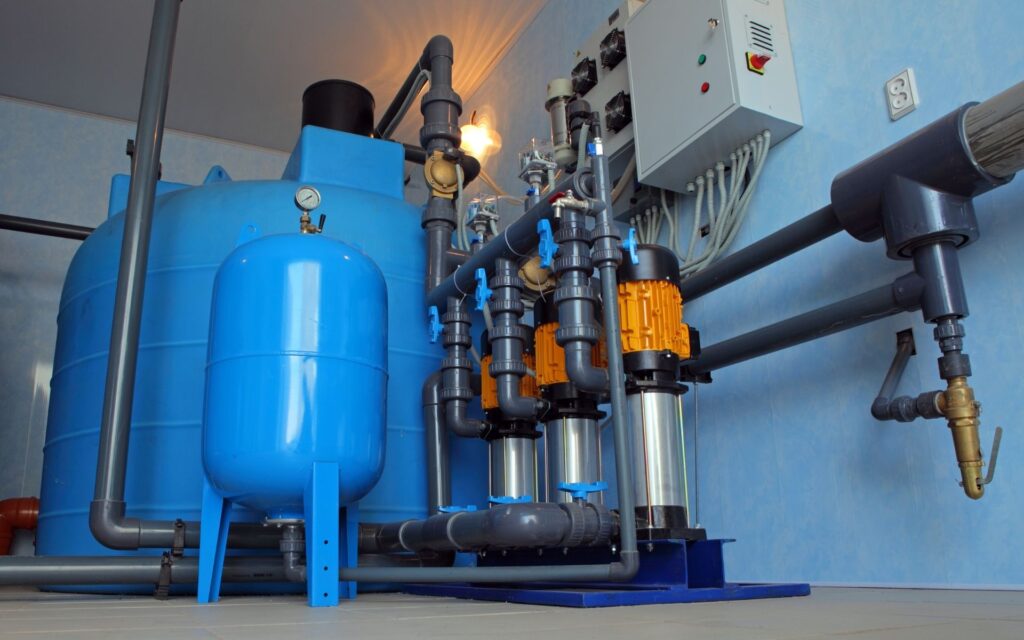
Which of these you have depends on your aquifer, your depth and your casing. The test is the only way to know.
Orange and brown staining in toilets, tubs and laundry, and a metallic taste. Above roughly 0.3 parts per million it also fouls softener resin.
Black or dark brown staining, often mistaken for iron and treated as if it were. It needs a slightly different approach and a higher pH to oxidise properly.
Hydrogen sulfide, the rotten-egg smell. Worst in hot water, and it needs oxidation or specialist media rather than plain carbon.
Sand, silt and fine grit that scores valve seats, blocks aerators and shortens the life of every component downstream of it.
Coliform and E. coli reach wells through surface run-off, flooding and casing faults. This is the one that needs a lab test rather than a field kit.
Calcium and magnesium, usually higher than the nearby city supply because nothing has been done to reduce it on the way.
Testing, design, installation and long-term service, all from the same company.
On-site testing for hardness, iron, manganese, pH, sulfur and sediment, with laboratory bacteria testing arranged where it is warranted.
A stage-by-stage design built from your results, in the right sequence, sized to your household and your well output.
Fitted by a WQA-certified, Texas Class 3 licensed technician, with the plumbing and bypasses set up so future servicing is straightforward.
Media replacement, UV lamp changes, resin cleaning, annual checks and 24/7 emergency repair, on our systems and on anyone else’s.
Sediment comes out first, because grit damages everything behind it. Iron and sulfur are oxidised and filtered next, because both will foul softener resin and blind a reverse osmosis membrane. Softening follows. Carbon goes after that. Ultraviolet goes last, because a UV lamp cannot disinfect water it cannot see through.
Get that sequence right and a well system runs for years with routine maintenance. Get it wrong and you will be replacing resin and membranes on a schedule that makes no sense to you, and nobody will be able to explain why.

Nobody should buy a water system from a brochure. Here is what actually happens.
We test what is coming out of your tap or your well, hardness in grains per gallon, iron, pH, odor, sediment, and look at your plumbing. About twenty minutes, no charge.
A written recommendation and a firm price based on your numbers and your household use. If a smaller unit does the job, we say so.
Installation by a licensed technician, then filters, settings checks and 24/7 repair for as long as you own the system.
We are not a franchise and we are not a call centre. The person who tests your water works for the company that installs and services it.
Deep roots in San Antonio and the Hill Country, and customers who have been with us for decades.
Class 3 certified by the Texas Water Commission and licensed by the Water Quality Association.
We install and service all major brands, even if the system was not purchased from us.
A leaking or failed system does not wait for business hours. Neither do we.
From single-family homes to restaurants, salons and industrial facilities, sized to the load.
On-site testing and a written estimate cost nothing, with no obligation attached.
This page is the overview. These cover each part properly.
Media, stages and sizing for iron, manganese, sulfur and sediment on a private well.

Annual testing, bacteria panels and the checks worth running after a flood.
Why softening a well is different, and what has to happen before the softener.
That depends entirely on what is in it, which is why the test comes first and costs nothing. Some Hill Country wells need only softening. Others need five or six stages. A few need very little. Nobody can tell you which without measuring.
That is hydrogen sulfide, and it is usually worse in hot water because heat drives it out of solution. It needs oxidation or specialist media to remove, a carbon filter will absorb it briefly and then stop.
Iron, almost always. Above around 0.3 parts per million it stains everything it touches, and it will also foul the resin in a water softener if it reaches one untreated.
It might be, but the only way to know is a laboratory bacteria test. Wells are open to surface contamination through run-off, flooding and casing faults, and none of that changes the taste or the appearance of the water.
Annually as a baseline, and additionally after flooding, after any work on the well or pump, if the taste, smell or colour changes, and before buying a property that depends on one.
On its own, usually not. A softener removes hardness and nothing else. Iron, sulfur, sediment and bacteria all need their own stages, and several of them will damage a softener if they are not dealt with first.
Private wells are not regulated the way city supplies are. Nobody tests your well water for you, and nobody sends you a yearly quality report. That responsibility sits with the owner, which is why testing is the first step in every well water job we take.
Hill Country geology sets the pattern. Limestone makes well water very hard, commonly 15 to 25 grains per gallon. Iron and manganese stain fixtures orange or black. Hydrogen sulfide gives well water the rotten egg smell. Sediment comes and goes after heavy rain.
Order of treatment matters more than brand of equipment. Sediment is removed first, then iron and sulfur, then hardness, then disinfection if bacteria are present. Softening well water before removing iron will foul the resin and shorten the life of the softener considerably.
Bacteria are the one result worth acting on immediately. If a coliform test comes back positive, we look at the wellhead and casing before selling anything, because a cracked cap or poor surface drainage is a more common cause than the aquifer itself.
Pressure and flow shape the design too. A well water system that treats beautifully but strangles flow to the showers will get switched off within a month, so we size filters to the pump curve rather than to a catalogue.
Maintenance for well water equipment is more involved than for city water. Media beds backwash, UV lamps are replaced annually, and sediment cartridges need changing on a schedule that suits your particular water rather than a generic interval.
We service every major brand of well water equipment, including systems we did not install, and we will tell you plainly when a repair makes more sense than a replacement.
| Symptom | Likely cause | Usual fix |
|---|---|---|
| Orange or brown staining | Iron in the well water | Oxidising iron filter ahead of the softener |
| Rotten egg smell | Hydrogen sulfide gas | Aeration or catalytic carbon filtration |
| Black specks | Manganese | Manganese-rated filtration media |
| Scale and poor lather | Hardness, often 15 to 25 gpg | Correctly sized ion-exchange softener |
| Cloudy after rain | Surface water reaching the well | Sediment filtration plus wellhead inspection |
| Positive coliform test | Bacterial contamination | Shock chlorination then UV disinfection |
Check any of this against the primary sources:
On-site testing across Boerne, Bulverde, Spring Branch, Kerrville, Comfort, Bandera, Blanco and the rest of the Hill Country.