Short answer: Well water treatment is not one product. It is a sequence of stages, chosen from a test of your own water, arranged so each stage protects the next. Get the order right and a system runs for years. Get it wrong and you replace resin every eighteen months.
What this guide covers
- Why well water treatment starts with a test
- The five stages and their order
- Stage one, sediment
- Stage two, iron and sulfur
- Stage three, softening
- Stage four, disinfection
- Stage five, drinking water polishing
- Maintenance that keeps it working
- What well water treatment costs
- Frequently asked questions
Why well water treatment starts with a test
A private well has no utility behind it. Nobody samples it, nobody reports on it, and nobody is required to tell you when something changes.
That makes testing the first stage of well water treatment rather than an optional extra. Hardness, iron, manganese, hydrogen sulfide, turbidity, pH and bacteria all change what equipment belongs on the wall.
Two properties on the same Hill Country road can draw from different fracture zones and need different systems. We test each address rather than assuming.
- 5 stagessediment, iron and sulfur, softening, disinfection, polishing
- 0.3 mg/Liron level that begins fouling softener resin
- Annuallyultraviolet lamp replacement interval
- Freeon-site well water testing across the Hill Country
The five stages and their order
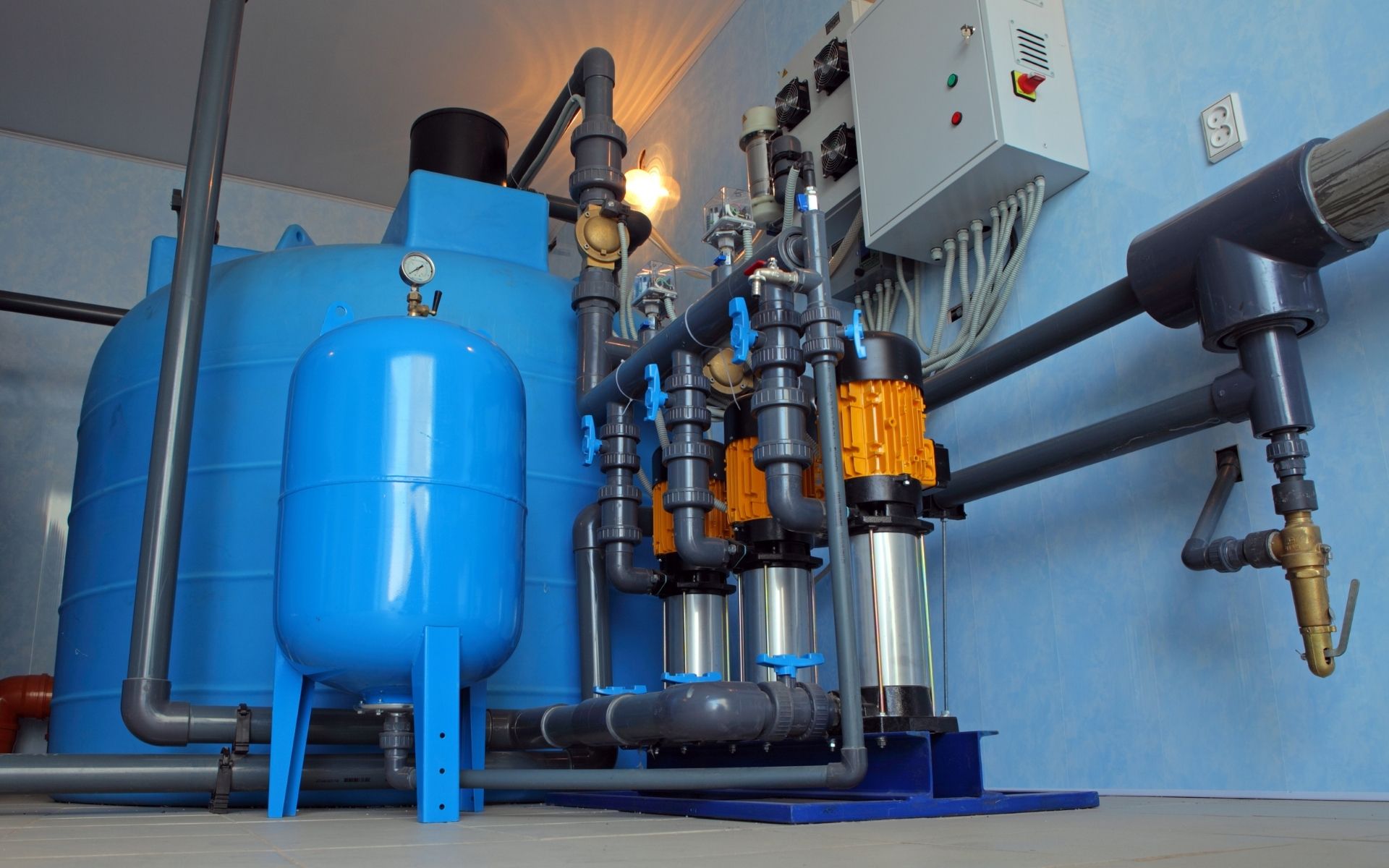
Effective well water treatment runs in a fixed order: sediment first, then iron and sulfur, then softening, then disinfection, then any point-of-use polishing at the kitchen tap.
Each stage protects the one behind it. Sediment would blind an iron filter. Iron would foul softener resin. Both would shorten the life of a reverse osmosis membrane.
Skipping a stage does not save money. It moves the cost to the next component, which fails early and takes the savings with it.
Stage one, sediment
Sand, silt and fine grit arrive from the formation itself or from a failing casing. After heavy Hill Country rain the load can spike for days.
A spin-down separator handles coarse material and can be flushed without opening anything. Cartridge filtration behind it catches the fine fraction.
Sediment is the cheapest stage and the one most often left out, which is why it accounts for so many premature failures further down the line.
- 1TestHardness, iron, sulfur, clarity, pH and bacteria measured at the tap.
- 2SequenceStages specified in the order that protects each component.
- 3InstallLicensed installation with the bypass and drain done properly.
- 4RetestWater checked again at service visits as the well changes.
Stage two, iron and sulfur
Iron above roughly 0.3 milligrams per litre stains fixtures and laundry an orange brown that ordinary detergent will not lift.
More importantly it coats softener resin, and coated resin stops exchanging. The softener still runs and still uses salt, but the water is no longer soft.
Hydrogen sulfide, the rotten egg smell, is a dissolved gas. Aeration, catalytic carbon or oxidising filtration handles it; a softener does nothing at all.
| Test result | Stage required | Typical equipment |
|---|---|---|
| Visible grit or cloudiness | Sediment | Spin-down plus cartridge filtration |
| Orange staining | Iron removal | Oxidising or catalytic media filter |
| Rotten egg odour | Sulfur removal | Aeration or catalytic carbon |
| Hardness above 7 gpg | Softening | Sized ion-exchange softener |
| Coliform present | Disinfection | Ultraviolet after clarification |
| Taste at the kitchen tap | Polishing | Under-sink reverse osmosis |
Stage three, softening
With the water clean, ion exchange removes the calcium and magnesium that cause scale. Capacity is calculated from household size, daily use and measured grains per gallon.
The target is regeneration every three to five days. More often than that wastes salt; much less often lets the resin bed channel.
Stage four, disinfection
Coliform bacteria are the most common failed test on Texas private wells, and they carry real health weight rather than nuisance weight.
Ultraviolet disinfection handles them without adding anything to the water, provided clarity upstream is good, which is exactly what stages one to three deliver.
A positive result should be retested and the wellhead inspected before equipment is specified, because the cause is often surface intrusion rather than the aquifer.
Stage five, drinking water polishing
Reverse osmosis at the kitchen sink is the final stage, and it is the one people notice most because it changes how the water tastes.
Placed behind proper well water treatment a membrane lasts for years. Placed on raw well water it clogs in months.
Not every household needs it. Where the well is clean and the softener is doing its job, we say so rather than selling a stage that adds nothing.
Maintenance that keeps it working
Cartridges are changed on a schedule set by the water, not by the calendar on the box. Heavy sediment means more frequent changes.
Media beds in iron filters need periodic checking and eventual replacement. Ultraviolet lamps lose output long before they stop glowing and are replaced annually.
We retest at service visits, because well chemistry drifts with drought, heavy rain and changes in local pumping.
What well water treatment costs
A single-stage softener is a modest investment. A full multi-stage system on a difficult well costs more, and the test is what tells you which you need.
When comparing quotes, ask which test results drove each stage, what the media replacement interval is, and what the warranty covers on the control valve.
Our testing is free and carries no obligation, and a fair number of visits end with us recommending nothing at all.
Frequently asked questions
What does well water treatment actually involve?
A test, then a sequence of stages chosen from the results: sediment, iron and sulfur removal, softening, disinfection and drinking water polishing.
Can one unit do everything?
Rarely. Combination units exist, but on most Hill Country wells separate stages in the right order last longer and cost less to run.
How often should a private well be tested?
At least annually, and immediately after any change in taste, smell or colour, or after flooding near the wellhead.
Will a softener remove iron?
No. Iron fouls softener resin. It must be removed upstream, which is the most common well water treatment mistake we are called out to fix.
Do I need reverse osmosis as well?
Only sometimes. Where the well is clean and the softener is working, it adds taste polish rather than safety.
Book a free well water test
We test on site for free across Boerne, Kerrville, Fredericksburg, New Braunfels, Canyon Lake and the wider Hill Country. You get the numbers in writing, with no obligation.
Related reading: well water services, water filtration systems, water testing and analysis, reverse osmosis systems. See also our complete water treatment systems.
More from this guide: well water purification, well water filtration stages and sediment filtration.
Sources and further reading: Texas Well Owner Network (Texas A&M AgriLife), EPA national primary drinking water regulations, Texas Water Development Board groundwater data.