
Short answer: Sediment filtration removes sand, grit, silt and clay from well water before that material reaches your softener, water heater and fixtures. In the Hill Country it is almost always the first stage in a well water system, because limestone country produces fine particles that clog and abrade everything downstream.
What this guide covers
- Why Hill Country wells carry sediment
- Signs your water needs sediment filtration
- How sediment filtration actually works
- Choosing between filter types
- Micron ratings explained
- Where it belongs in the treatment train
- Maintenance and running costs
- What it costs to run
- What you can check yourself
- Frequently asked questions
Why Hill Country wells carry sediment
The Texas Hill Country sits on fractured limestone. Water moves through cracks and channels rather than filtering slowly through deep sand, so it arrives at the wellhead carrying whatever it picked up along the way. That is the fundamental reason sediment filtration matters more here than in regions with different geology.
Rainfall makes it seasonal. After a heavy storm many Kendall, Kerr and Comal County wells run cloudy for several days as surface water pushes fine clay into the aquifer. Households often notice grit in aerators first, then cloudiness in a filled bathtub.
Older wells add a second source. Casing that has corroded or a screen that has degraded lets larger material in directly, and no amount of sediment filtration downstream fixes a well that needs mechanical repair.
Signs your water needs sediment filtration
- 15-25grains per gallon typical Hill Country hardness
- 5 microncommon final stage for household sediment filtration
- 3-12 motypical cartridge life depending on load
- 24/7emergency service across the Hill Country
Grit in faucet aerators and showerheads is the clearest sign. Cloudy water that clears from the bottom up when left standing in a glass is another, and it distinguishes sediment from air bubbles, which clear from the top down.
Less obvious symptoms include a softener that regenerates more often than its size suggests, a water heater that rumbles, and toilet fill valves that stick. All three are consistent with particles that sediment filtration should have removed.

How sediment filtration actually works
Every form of sediment filtration is mechanical. Water passes through a barrier with openings small enough to stop particles above a chosen size, and the trapped material either accumulates in a cartridge or is periodically flushed to drain.
That simplicity is why sediment filtration is reliable and why sizing matters. Too fine a barrier clogs quickly and drops household pressure. Too coarse a barrier passes material that damages equipment downstream.
- 1Test the waterMeasure turbidity, particle size and flow rate before specifying anything.
- 2Match to flowSize the housing to your pump curve and simultaneous fixture demand.
- 3Stage the filtrationCoarse pre-filter first, finer polish second where the load justifies it.
- 4Set a scheduleChange or backwash on an interval matched to your actual water.
Choosing between filter types
There are three practical options for household sediment filtration, and the right one depends on how much material your well produces and how much maintenance you want to do.
| Type | How it handles debris | Best suited to | Upkeep |
|---|---|---|---|
| Spin-down separator | Centrifugal action drops grit into a clear bowl | Wells with visible sand after rain | Flush the bowl, no cartridge cost |
| Cartridge filter | Pleated or depth media traps particles | Most Hill Country homes | Replace every 3 to 12 months |
| Backwashing media | Bed of graded media, flushed automatically | Heavy or continuous sediment loads | Needs a drain, minimal handling |
| Two-stage combination | Spin-down then cartridge polish | Wells that surge after storms | Longest cartridge life |
Micron ratings explained
A micron rating describes the smallest particle a filter reliably stops. Lower numbers catch finer material but clog faster, which is the central trade-off in sediment filtration.
For context, a grain of fine sand is roughly 100 microns and human hair is around 70. Most household sediment filtration ends at 5 microns, which protects softener resin and reverse osmosis membranes without strangling flow.
Nominal and absolute ratings are not the same thing. A nominal 5 micron cartridge stops most particles at that size; an absolute rating is a stricter guarantee and costs more. For general sediment filtration ahead of a softener, nominal is normally sufficient.
It is worth being precise about what sediment filtration does not do, because the wrong expectation is the commonest reason homeowners feel let down by a system that is in fact working correctly.
It does not soften water. Hardness is dissolved calcium and magnesium, and dissolved minerals pass through a mechanical barrier untouched. A hardness test after sediment filtration reads exactly the same as before.
It does not remove dissolved iron either. Iron only becomes filterable once it has oxidised into a particle, which is why iron filters use an oxidising media rather than a simple screen.
And it does not address nitrates, which are dissolved and need reverse osmosis or a specific ion-exchange resin. On wells near agriculture or older septic systems, nitrate testing is worth doing regardless of how clear the water looks.
Where it belongs in the treatment train
Sediment filtration goes first, before iron removal, before softening and before any ultraviolet disinfection. This order is not a preference, it is a requirement.
Iron filters and softeners both rely on media beds that abrade and channel when grit passes through them. UV needs clear water because particles shield bacteria from the lamp. Skipping sediment filtration to save money almost always costs more in shortened equipment life.
Where a well tests clean apart from hardness, a single sediment stage plus a correctly sized softener is often the whole system. We would rather install that than sell a train of vessels nobody needs.

Maintenance and running costs
Cartridge sediment filtration is the cheapest to install and the most hands-on to run. Expect to change cartridges somewhere between quarterly and annually depending on how much material your well carries.
Backwashing systems cost more up front, need a drain connection, and largely look after themselves. On wells that surge after every storm they usually work out cheaper over five years.
A pressure gauge either side of the filter is the single most useful upgrade. When the difference between the two climbs by about 10 psi, the cartridge is due, and you stop guessing.
The well itself matters more than the filter
If a well produces sediment suddenly and persistently, the honest first step is to inspect the well rather than to sell more sediment filtration. A cracked casing, a failed sanitary seal or a pump set too close to the bottom of the borehole all produce material that no filter should be asked to handle continuously.
Pump depth is a common culprit on older installations. A pump sitting near the base of the well stirs accumulated silt every time it cycles, and raising it can reduce the load dramatically.
Surface drainage is the other one. Ground that slopes toward the wellhead rather than away from it lets rainwater carry soil straight to the casing. That is a landscaping fix, not a filtration one, and it usually also resolves the bacteria results that accompany it.
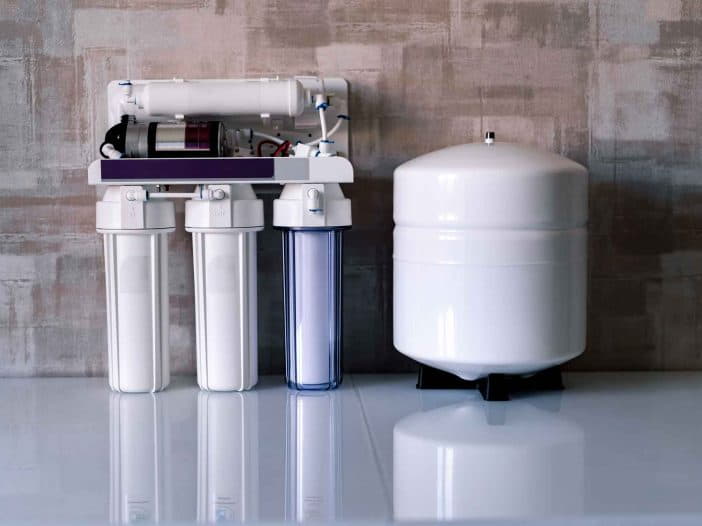
What sediment filtration costs to run
Homeowners nearly always ask about price before anything else, and the honest answer is that installation is the smaller number over a ten year horizon. Running cost is what separates the options.
A single cartridge housing is inexpensive to fit. If your well is mild you might change a cartridge twice a year, and the annual cost is small. If your well surges after every storm you could be changing monthly, and that same cheap housing becomes the expensive choice.
A backwashing unit costs several times more to install but consumes no cartridges. It does use water to flush, and it needs a drain, so it suits properties where those are available and where the sediment load genuinely justifies it.
The two-stage approach is what we fit most often on Hill Country wells. A spin-down separator catches the coarse material and is simply flushed by hand, which means the fine cartridge behind it lasts far longer than it would on its own.
What you can check yourself
Before calling anyone, two observations narrow the problem usefully. Fill a clear glass and let it stand for ten minutes. If particles settle to the bottom, that is sediment. If the cloudiness clears from the top downward, it is dissolved air and nothing is wrong.
Second, check whether the problem is constant or event-driven. Grit that appears only after heavy rain points at surface water reaching the well. Grit that is always present points at the casing, the screen or the pump.
Note the answers before the visit. A technician arriving with that information can often specify sediment filtration on the first call rather than the second.
Frequently asked questions
Does sediment filtration remove bacteria?
No. Sediment filtration is mechanical and removes particles, not microorganisms. Bacteria need ultraviolet disinfection or chlorination, and clear water first for either to work properly.
Will it fix rotten egg smell?
No. That odor is hydrogen sulfide, a dissolved gas, and it passes straight through a sediment filter. It needs aeration or catalytic carbon.
Will a sediment filter reduce my water pressure?
Only if it is undersized or overdue for a change. Correctly sized sediment filtration causes a pressure drop small enough that households do not notice it.
How often should cartridges be changed?
Between three and twelve months for most Hill Country wells. A pressure gauge either side of the housing turns that guess into a measurement.
Do I need sediment filtration on city water?
Usually not. Municipal supplies are already filtered. It is occasionally useful after mains work stirs up a line, but it is primarily a well water measure.
Find out what is actually in your well water
We test on site for free across Boerne, Kerrville, Fredericksburg, New Braunfels, Canyon Lake and the wider Hill Country. You get the numbers in writing, with no obligation to buy anything.
Related reading: well water filtration systems, well water services, water softeners and free water testing.
More from this guide: removing iron from well water, whole house versus point of use and our filtration services.
Sources and further reading: Texas Well Owner Network (Texas A&M AgriLife), EPA national primary drinking water regulations, Texas Water Development Board groundwater data.