
Short answer: Water filtration on a private well is a sequence, not a box. Each stage has one job and exists to protect the stage behind it. Get the order right and the system runs for years; get it wrong and you replace the most expensive component first.
What this guide covers
Water filtration starts with a test
A private well has no utility behind it, no annual report and no routine sampling. Nothing about it has been checked unless the owner arranged it.
That makes measurement the first stage. Hardness, iron, manganese, hydrogen sulfide, turbidity, pH and bacteria each change what belongs on the wall.
Two properties on the same Hill Country road can draw from different fracture zones and need genuinely different water filtration.
- 5 stagessediment, iron and sulfur, softening, disinfection, polishing
- 0.3 mg/Liron level that begins fouling softener resin
- Annuallyultraviolet lamp replacement interval
- Freeon-site well water testing across the Hill Country
Sediment, the stage most often skipped
Sand, silt and fine grit arrive from the formation itself or from an ageing casing, and the load spikes for days after heavy rain.
A spin-down separator catches coarse material and can be flushed without opening anything. Cartridge filtration behind it takes the fine fraction.
It is the cheapest stage and the one left out most often, which is why it accounts for so many premature failures further down the line.
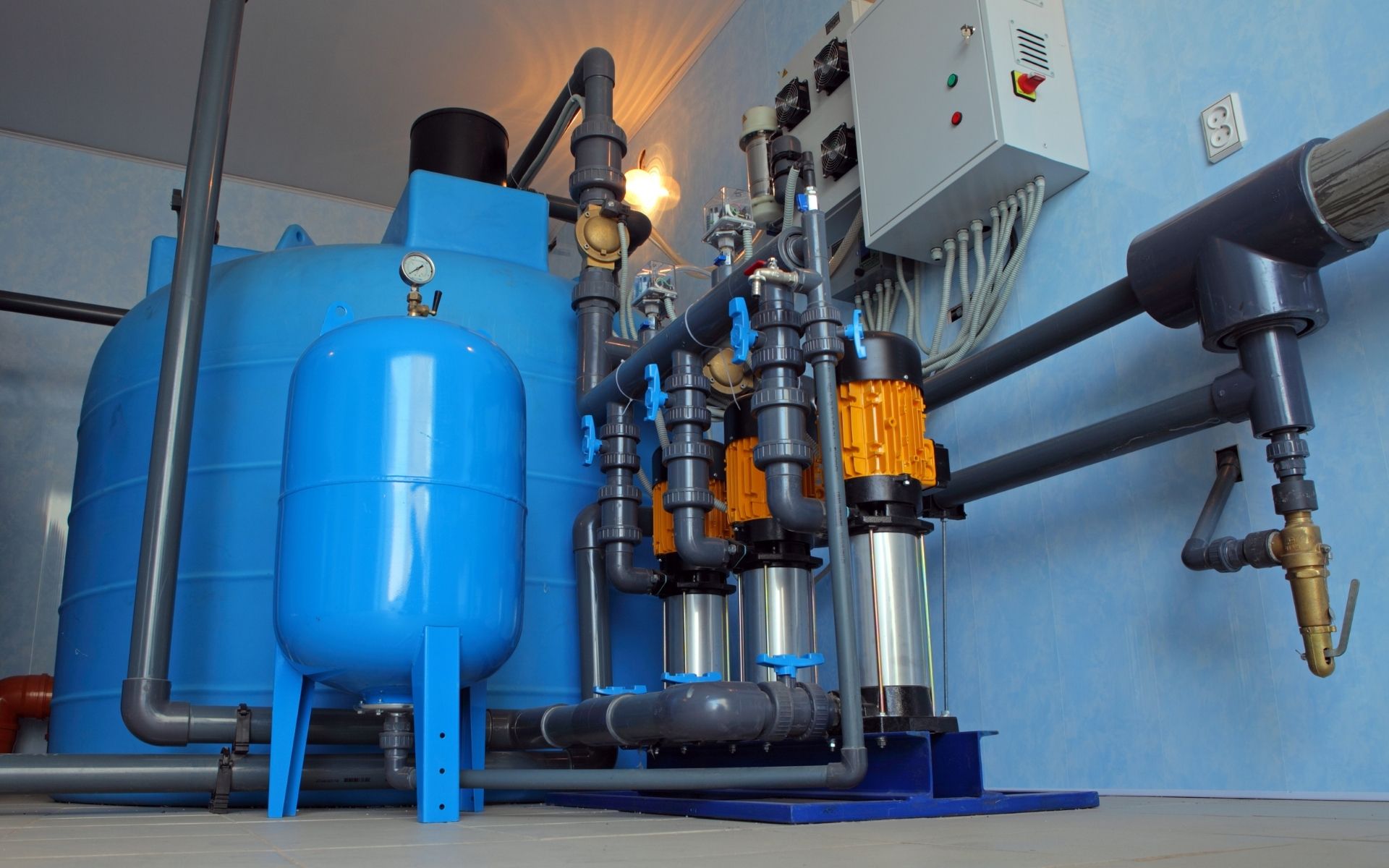
Iron and manganese removal
Iron above roughly 0.3 milligrams per litre stains fixtures and laundry an orange brown that ordinary detergent will not lift.
It also coats softener resin, and a coated bed stops exchanging. The unit keeps regenerating and keeps burning salt while delivering hard water.
Oxidising and catalytic media handle both iron and manganese, and they belong upstream of the softener rather than after it.
- 1TestHardness, iron, sulfur, clarity, pH and bacteria measured on site.
- 2ClarifySediment and metals removed before anything else is fitted.
- 3SoftenIon exchange sized to your household and measured hardness.
- 4DisinfectUltraviolet last, where the water is already clear.
Sulfur and the rotten egg smell
Hydrogen sulfide is a dissolved gas rather than a particle, so ordinary cartridge water filtration does very little to it.
Aeration drives it off, and catalytic carbon adsorbs what remains. Which suits a property depends on concentration and on flow rate.
A softener does nothing to it at all, which surprises a lot of owners who bought one hoping the smell would go.
| Stage | What it removes | Why it sits there |
|---|---|---|
| Spin-down and cartridge | Sand, silt, turbidity | Protects everything downstream |
| Oxidising media | Iron and manganese | Stops resin fouling |
| Aeration or catalytic carbon | Hydrogen sulfide | Gas, not a particle |
| Ion exchange | Calcium and magnesium | Needs clean water to last |
| Ultraviolet | Bacteria and viruses | Needs clarity to reach organisms |
| Reverse osmosis | Dissolved solids, nitrate, arsenic | Point of use, final polish |
Carbon and what it is actually for
Carbon adsorbs chlorine, taste and odour compounds and a range of organics, and it is the workhorse of most household water filtration.
On a private well there is no chlorine to remove, so carbon here is about taste, odour and organics rather than disinfectant.
It has a finite capacity and needs replacing on a schedule set by the water rather than by the label on the box.

Ultraviolet disinfection
Coliform is the most commonly failed test on Texas private wells, and unlike hardness it carries real health weight.
Ultraviolet inactivates bacteria without adding anything to the water, but it needs clear water to work, because suspended particles shadow the organisms.
That is why UV sits at the end of the sequence rather than the start, behind everything that makes the water clear.
Reverse osmosis at the kitchen tap
Reverse osmosis removes dissolved solids, nitrate, arsenic and lead, and it is the final polish rather than a whole-house solution.
Behind proper pre-treatment a membrane lasts for years. On raw well water it can clog within months.
Not every household needs it, and where the water is already clean we say so rather than selling a stage that adds little.
Maintaining the sequence
Cartridges are changed on a schedule set by your water. Heavy sediment means more frequent changes than any manufacturer figure suggests.
Media beds need periodic checking and eventual replacement, and ultraviolet lamps lose output long before they stop glowing.
We retest at service visits, because well chemistry drifts with drought, heavy rain and changes in local pumping.
How we work
We test, specify and fit water filtration across Boerne, Kerrville, Fredericksburg, New Braunfels, Canyon Lake, Bandera and San Antonio.
We service every major brand, including systems we did not install and equipment left behind by companies that have closed.
Testing is free and carries no obligation, and a fair share of visits end with us recommending nothing at all.
Frequently asked questions
What does well water filtration involve?
A test, then a sequence: sediment, iron and sulfur removal, softening, ultraviolet disinfection and drinking-water polishing.
Can one unit do everything?
Rarely. On most Hill Country wells, separate stages in the right order last longer and cost less to run than a combination unit.
Will filtration remove hardness?
No. Sediment and carbon filtration improve clarity and taste. Only ion exchange removes calcium and magnesium.
Why does UV go last?
Suspended particles shadow bacteria from the lamp. Ultraviolet only works reliably once the water upstream is clear.
How often are cartridges changed?
On a schedule set by your water rather than by the box. Heavy sediment means more frequent changes.
Book a free well water filtration test
We test on site for free across Boerne, Kerrville, Fredericksburg, New Braunfels, Canyon Lake and the wider Hill Country. You get the numbers in writing, with no obligation.
Related reading: water filtration systems, well water services, water testing and analysis, reverse osmosis systems. See also our complete water treatment systems.
More from this guide: sediment filtration, removing iron from well water and whole house versus point of use.
Sources and further reading: Texas Well Owner Network (Texas A&M AgriLife), EPA national primary drinking water regulations, Texas Water Development Board groundwater data.