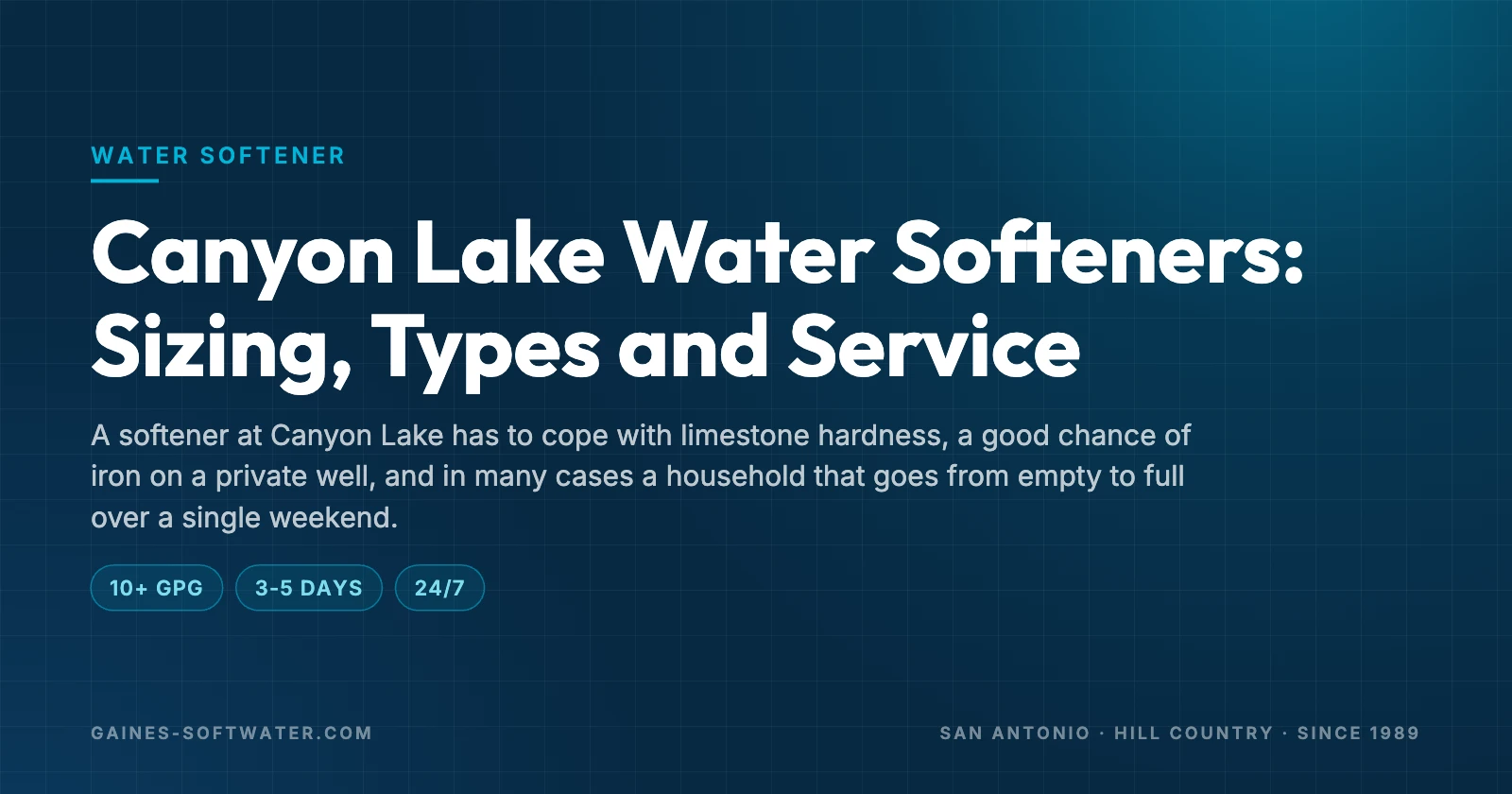
Short answer: A softener at Canyon Lake has to cope with limestone hardness, a good chance of iron on a private well, and in many cases a household that goes from empty to full over a single weekend. Sizing for the average week is how these systems end up failing.
What this guide covers
What a softener is up against here
Both the Edwards and Trinity aquifers feed the Canyon Lake area, and both move through limestone.
That gives calcium and magnesium readings commonly in double digits in grains per gallon, which every published scale calls very hard.
On the public supply that hardness arrives unchanged, because treatment is designed to make water safe rather than soft.
- 10+ gpgtypical hardness around Canyon Lake, classed very hard
- 3-5 dayscorrect regeneration interval when sized properly
- Peak, not averagehow a guest property should be sized
- 24/7emergency callout across Comal County
How a softener actually works
In a Canyon Lake home, water passes through a bed of resin beads holding sodium ions. Calcium and magnesium swap places with that sodium and stay on the resin.
When the bed is loaded, the control valve draws brine from the salt tank and flushes the hardness to drain, resetting the resin for the next cycle.
Everything that goes wrong is a variation on that: fouled resin, a valve that has stopped metering, or a bed sized for the wrong household.
Sizing for a lake-area household
Capacity for a Canyon Lake softener is arithmetic. Household size times daily consumption times measured grains per gallon gives the daily load in grains.
The unit is chosen so it regenerates every three to five days at that load. More often wastes salt; much less often lets the bed channel.
The complication at Canyon Lake is occupancy. A second home that sleeps two midweek and ten at the weekend needs sizing for the ten.
- 1TestHardness and iron measured at your own tap, free of charge.
- 2CalculateDaily load worked out from peak occupancy, not the average week.
- 3SpecifyCapacity and valve chosen to regenerate every three to five days.
- 4InstallLicensed fitting with bypass, air gap and legal drain.
Second homes and short-term lets
At Canyon Lake, peak demand is the number that matters, because a softener that runs out mid-weekend has failed in the only week the guests remember.
Long vacancies bring the opposite problem, letting water sit in the resin bed and the plumbing for weeks at a time.
A regeneration schedule that cycles the bed during quiet periods, and a flush after a long vacancy, both help more than most owners expect.
| System | Best suited to | Trade-off |
|---|---|---|
| Single-tank metered | Full-time family homes | Brief hard water during regeneration |
| Twin-tank | Guest properties and short-term lets | Higher purchase cost |
| Salt-free conditioner | Low hardness, no salt discharge | Does not remove hardness |
| Softener plus iron filter | Private wells with staining | Extra media replacement |
| Softener plus carbon | Public supply with chlorine taste | Two units to service |
| Softener plus RO | Households wanting better drinking water | Annual cartridge changes |
If you are on a private well
Iron is the most frequent finding on Canyon Lake wells, and it coats softener resin. A fouled bed keeps regenerating and keeps consuming salt while delivering hard water.
It must be removed upstream. Putting a softener ahead of iron removal is the single most expensive mistake in well treatment.
Sediment belongs ahead of both, because grit blinds every stage downstream of it.

The types worth considering
Around Canyon Lake a single-tank metered softener suits most family homes and regenerates on actual use rather than on a timer.
Twin-tank systems give uninterrupted soft water and genuinely earn their cost on guest properties with sharp demand peaks.
Salt-free conditioners reduce scale adhesion without removing hardness, which suits some situations and not others.
Installation done properly
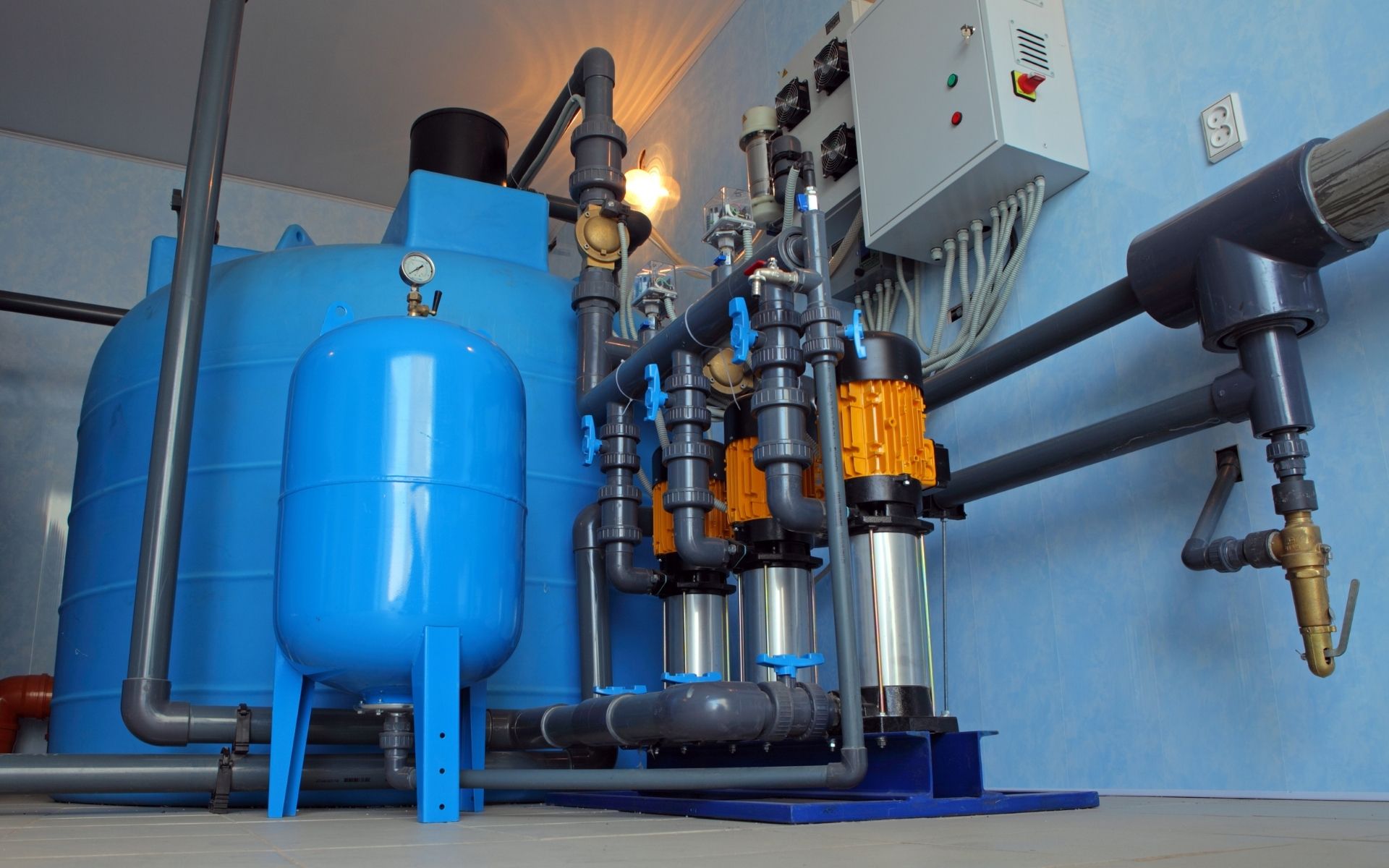
In a Canyon Lake install the unit belongs on the main line after the meter or pressure tank and before the water heater, with a bypass fitted for service.
The drain needs an air gap and a legal discharge point, and this is the detail most often improvised on a rushed job.
Outdoor installations are common around the lake and need protection from summer heat and the occasional hard freeze.
When a softener is failing
On any Canyon Lake softener, salt consumption rising without a change in household size usually means fouled resin or a valve that has stopped metering.
Water feeling hard again after years of being soft points at an exhausted bed, and on a well that usually traces back to iron.
A unit that regenerates constantly, or never, is a control problem and is frequently repairable rather than a write-off.
Service on any brand
A lot of equipment around the lake was fitted by firms that have since closed, leaving owners with no service history and no support.
We service every major brand, including systems we did not install, and we start by testing rather than trusting the original specification.
Testing is free, emergency callout runs around the clock, and a fair share of visits end with us recommending nothing at all.
Frequently asked questions
How hard is the water at Canyon Lake?
Commonly double digits in grains per gallon, because both aquifers here move through limestone. We measure at your tap.
What size softener does a weekend property need?
One sized for peak occupancy rather than the average week, or it will run out exactly when the house is full.
Will a softener remove iron from my well?
No. Iron fouls softener resin and must be removed upstream. It is the most common sequencing mistake we correct.
Where should it be installed?
After the meter or pressure tank and before the water heater, with a bypass and a legal drain with an air gap.
Do you service systems you did not install?
Yes, on every major brand, starting with a water test rather than an assumption.
Book a free softener sizing visit at Canyon Lake
We test on site for free across Boerne, Kerrville, Fredericksburg, New Braunfels, Canyon Lake and the wider Hill Country. You get the numbers in writing, with no obligation.
Related reading: Canyon Lake water softeners, water softeners, softener repair and service, well water services.
More from this guide: how a softener is installed, well water around Boerne and wells near Fredericksburg.
Sources and further reading: Texas Well Owner Network (Texas A&M AgriLife), EPA national primary drinking water regulations, Texas Water Development Board groundwater data.
Also worth reading: what a softener costs and the tax question.