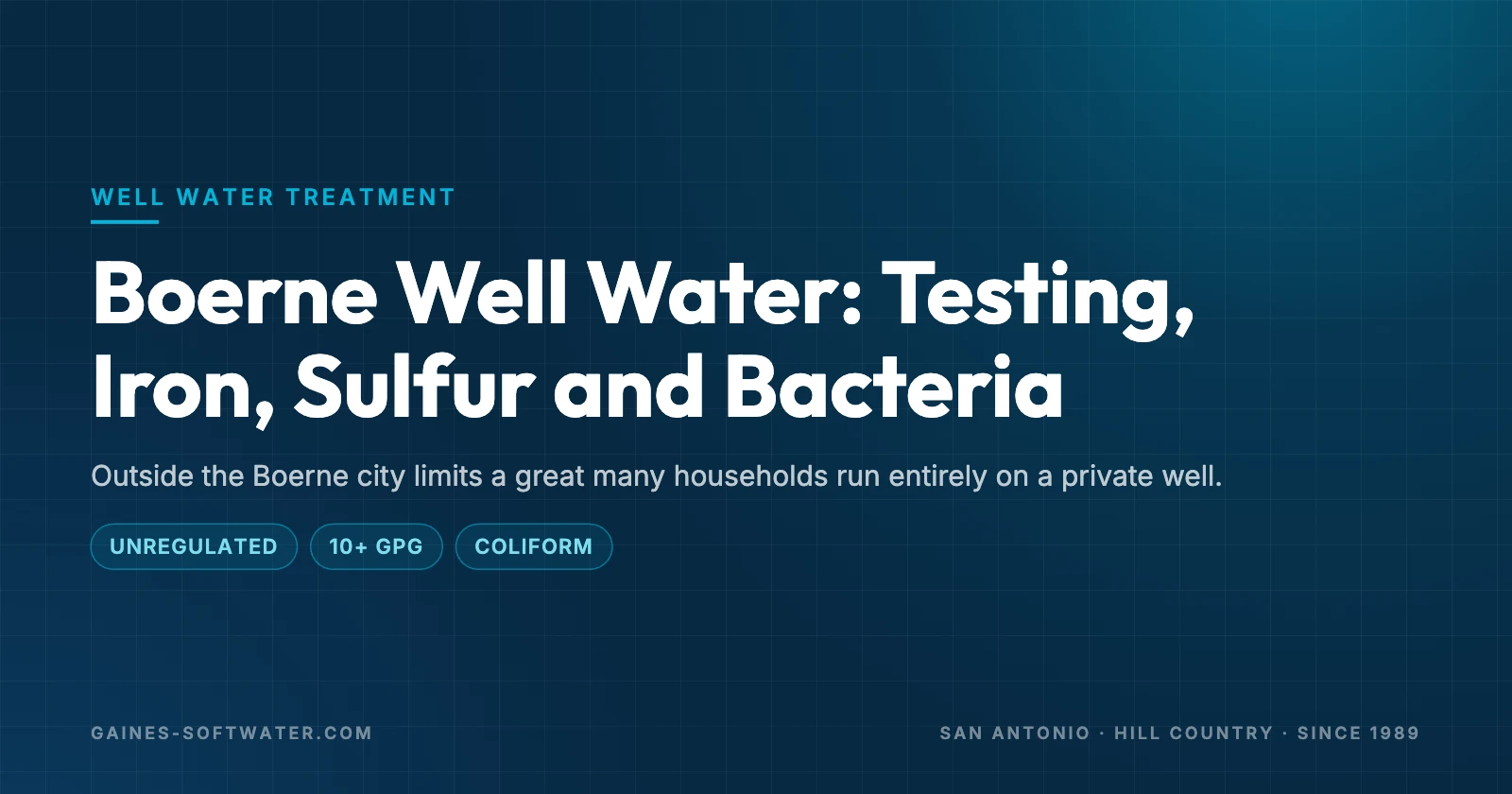
Short answer: Outside the Boerne city limits a great many households run entirely on a private well. There is no utility behind it, no annual report, and no requirement that anyone tell you when the water changes. What you know about it is exactly what you have tested.
What this guide covers
- Why Boerne well owners start with a test
- Trinity and Edwards water
- Iron and what it does to a softener
- Sulfur, sediment and seasonal swings
- Bacteria and the results that matter
- The order that protects your equipment
- Sizing for a Kendall County property
- Maintenance that keeps it running
- Where we work
- Frequently asked questions
Why Boerne well owners start with a test
Public systems in Texas are sampled, reported and regulated. Private wells are not, and around Boerne that covers a large share of properties.
Nobody is checking the water between your well casing and your kitchen tap. The only information that exists is what the owner arranges.
That is why our first visit is a free test rather than a quotation, and why a fair number of those visits end with us recommending nothing.
- Unregulatedprivate wells in Texas are not sampled or reported
- 10+ gpgtypical hardness on Boerne area wells
- Coliformthe most commonly failed test on Texas wells
- Freeon-site well testing across Kendall County
Trinity and Edwards water
Wells around Boerne generally draw from the Trinity or the Edwards aquifer, both of which move through limestone.
That produces hardness, commonly in double digits in grains per gallon, which every published scale calls very hard.
Depth matters. Two properties on the same road in Kendall County can hit different zones and return genuinely different results.
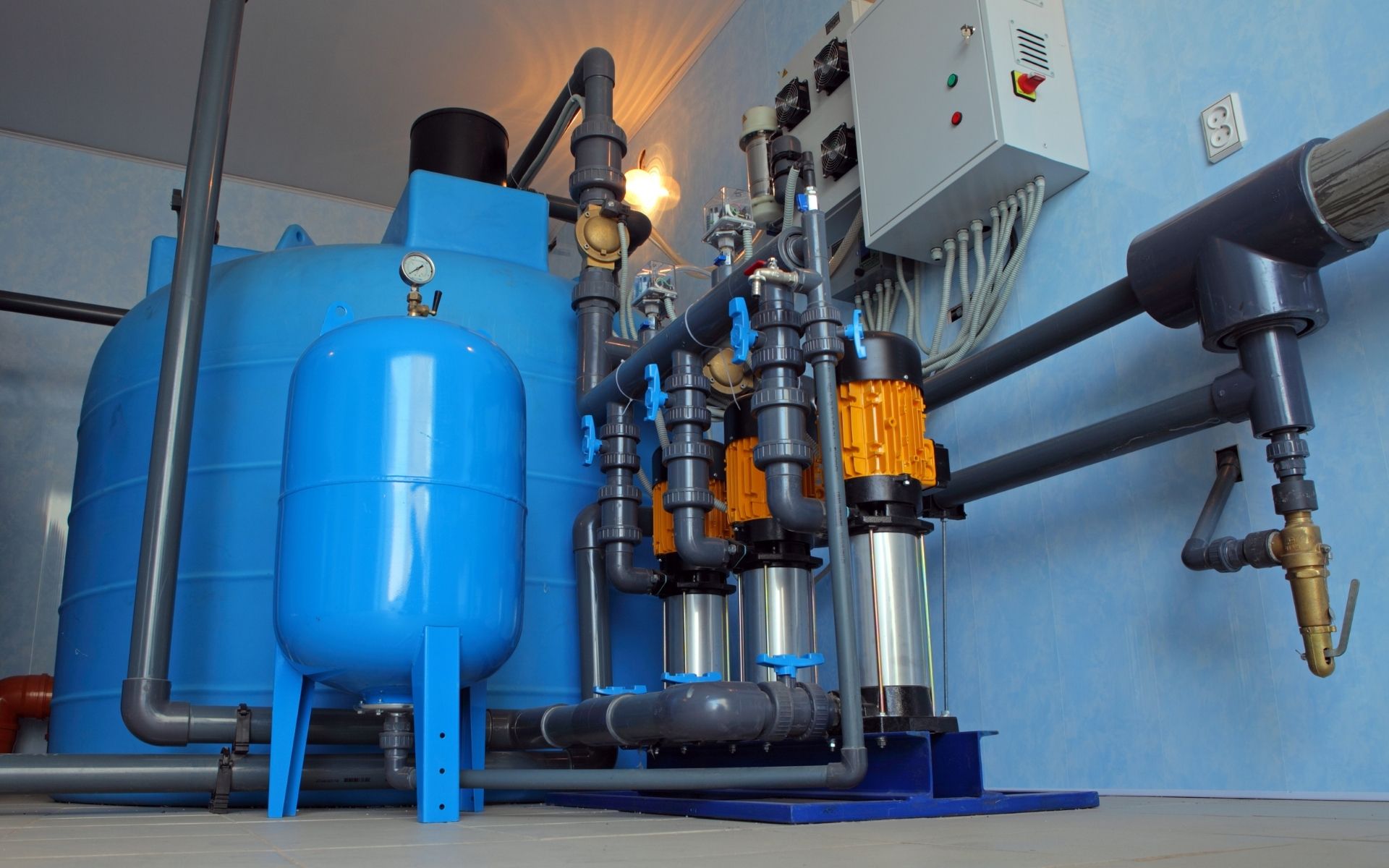
Iron and what it does to a softener
Orange staining in basins and on laundry is dissolved iron, and it is the most frequent finding on wells in this area.
It coats softener resin. A coated bed keeps regenerating and keeps consuming salt while delivering water that is no longer soft.
Removing it upstream is not an upsell. It is what stops you buying resin twice, and it is the sequencing error we correct most often.
- 1TestHardness, iron, sulfur, clarity, pH and bacteria measured on site.
- 2SequenceStages specified in the order that protects each component.
- 3InstallLicensed installation with the bypass and drain done properly.
- 4RetestWater checked again at service visits as the well changes.
Sulfur, sediment and seasonal swings
Hydrogen sulfide produces the rotten egg smell. It is a dissolved gas, so a softener does nothing to it and filtration alone does little.
Sediment spikes after heavy rain, particularly in shallower formations and near Cibolo Creek, and it blinds whatever sits downstream.
Drought does the opposite, concentrating dissolved minerals as the water table falls. A test from years ago is history rather than information.
| Test result | What it means | Stage required |
|---|---|---|
| High turbidity | Sediment from the formation or casing | Spin-down plus cartridge filtration |
| Iron above 0.3 mg/L | Staining and resin fouling | Iron filter before the softener |
| Sulfur odour | Hydrogen sulfide gas | Aeration or catalytic carbon |
| Hardness above 7 gpg | Scale and soap waste | Sized ion-exchange softener |
| Coliform present | Health risk, needs retest | Ultraviolet after clarification |
| Taste at the kitchen tap | Dissolved solids | Under-sink reverse osmosis |
Bacteria and the results that matter
Coliform is the most commonly failed test on Texas private wells, and unlike hardness it carries genuine health weight.
A positive result should be retested and the wellhead inspected, because the cause is often surface intrusion rather than the aquifer itself.
Ultraviolet disinfection handles bacteria without adding anything to the water, provided upstream clarity is good.

The order that protects your equipment
Sediment first, then iron and sulfur, then softening, then disinfection, then any drinking-water polishing at the kitchen tap.
Each stage protects the next. Skipping one does not save money; it relocates the cost to whichever component fails early.
Sizing for a Kendall County property
Capacity is arithmetic: household size, daily consumption and measured grains per gallon give the load, and the unit regenerates every three to five days.
Larger properties around Boerne often run long pipe runs, several bathrooms and outbuildings on one supply, which changes both the sizing and the placement.

Maintenance that keeps it running
Cartridges are changed on a schedule set by the water rather than by the calendar on the box. Heavy sediment means more frequent changes.
Media beds need periodic checking and eventual replacement, and ultraviolet lamps lose output long before they stop glowing.
We retest at service visits, because well chemistry drifts with drought, heavy rain and changes in local pumping.
Where we work
We cover Boerne and the wider Kendall County area, along with Comfort, Fair Oaks Ranch, Bulverde, Kerrville and San Antonio.
We service every major brand, including systems we did not install and equipment left behind by companies that have closed.
Emergency callout runs around the clock, because a leaking or bypassed system is a today problem.
Frequently asked questions
How often should a Boerne well be tested?
Annually at minimum, and immediately after any change in taste, smell or colour, or after flooding near the wellhead.
Is well water around Boerne safe to drink?
It can be, but nothing is guaranteed. Private wells are unregulated, so safety is only known once the water is tested.
Will a softener remove iron from my well?
No. Iron fouls softener resin and must be removed upstream. It is the most common sequencing mistake we correct.
What causes the rotten egg smell?
Hydrogen sulfide gas. Aeration or catalytic carbon removes it; a softener and a plain filter will not.
Do you cover properties outside the city limits?
Yes. Wells across Kendall County, Comfort and Fair Oaks Ranch are a large part of our Boerne work.
Book a free well water test near Boerne
We test on site for free across Boerne, Kerrville, Fredericksburg, New Braunfels, Canyon Lake and the wider Hill Country. You get the numbers in writing, with no obligation.
Related reading: well water services, Boerne water softeners, water testing and analysis, water filtration systems.
More from this guide: wells near Fredericksburg, San Antonio well water and maintaining a San Antonio well. Also worth reading: hard water on a private well.
Sources and further reading: Texas Well Owner Network (Texas A&M AgriLife), EPA national primary drinking water regulations, Texas Water Development Board groundwater data.