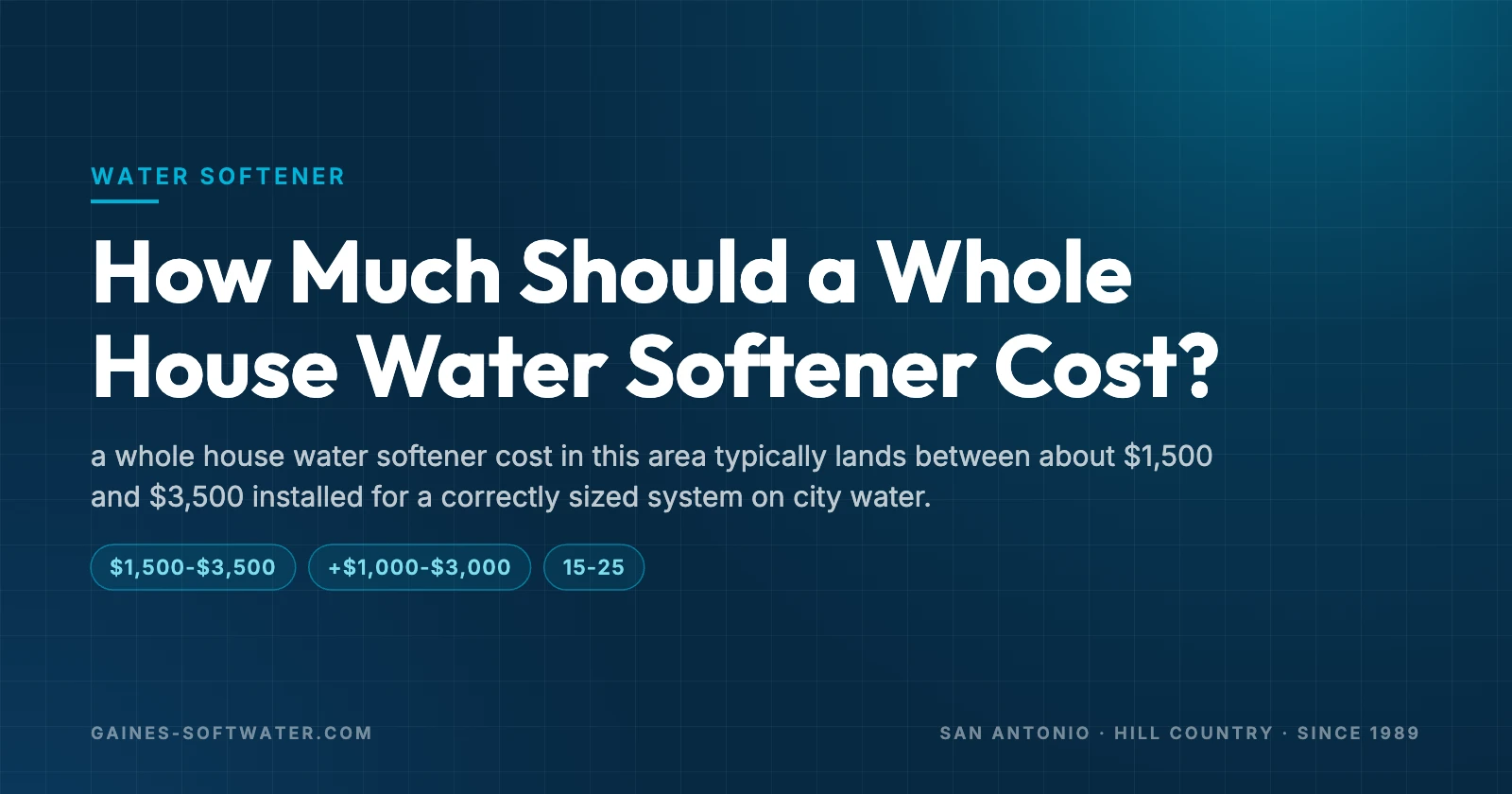
Short answer: a whole house water softener cost in this area typically lands between about $1,500 and $3,500 installed for a correctly sized system on city water. Wells needing iron or sediment pre-treatment run higher. Entry-level equipment bought and fitted yourself costs far less, and lasts accordingly. The only accurate number comes from a test at your own tap.
What this guide covers
- What the range actually looks like
- What moves the equipment price
- What moves the installation price
- Wells cost more, and the reason matters
- The costs that continue after year one
- How to compare two quotes fairly
- Why the cheapest quote is often the dearest
- Where reverse osmosis and salt-free fit
- What you get back
- Getting a real number for your house
- Frequently asked questions
What the range actually looks like
For a straightforward city-water home in Boerne, New Braunfels or San Antonio, a properly sized softener installed by a licensed company usually falls between about $1,500 and $3,500. That water softener cost covers the equipment, the fitting, the bypass and a legal drain connection.
Below that sits self-installed equipment from a big box store, commonly $400 to $900 for the unit alone. Above it sit twin-tank systems and high-capacity units for large households, which can reach $4,000 or more.
Treat every published water softener cost, including this one, as a starting point rather than a quote. Hardness, household size, plumbing layout and whether you are on a well all move the figure before anyone visits.
What moves the equipment price
Grain capacity is the biggest single driver of water softener cost. A larger resin bed costs more, and a household of six at twenty grains per gallon genuinely needs more capacity than a couple at twelve.
The control valve is next. A metered valve that regenerates on actual water use costs more than a timer and saves salt every month afterwards, so it usually pays for itself inside the warranty period.
Resin grade, tank quality and warranty terms account for most of the rest. This is where a low water softener cost is often achieved, by fitting a smaller bed, a basic valve and standard resin, and none of that is visible in a headline price.
- $1,500-$3,500typical installed range on city water in this area
- +$1,000-$3,000typical pre-treatment addition on a private well
- 15-25grains per gallon typical Hill Country hardness
- 10-15 yrsresin life on clean municipal water

What moves the installation price
Where the main line runs decides most of the installed water softener cost. A softener sitting near an accessible main with a drain close by is a straightforward morning. One that needs pipework rerouted across a garage is not.
A proper installation includes a bypass so the house can run without the unit during service, an air gap on the drain, and a discharge point that is legal for the property. Those details are what separate an installed price from a delivered box.
Outdoor installations are common here and need protection from summer heat and the occasional hard freeze. Building that in costs a little now and avoids a valve replacement later.
- 1TestHardness, iron and clarity measured at your own tap, free of charge.
- 2CalculatePeople times daily use times grains per gallon gives the daily load.
- 3SpecifyCapacity, valve and any pre-treatment, itemised separately.
- 4CompareSame four numbers from every company, then weigh local service.
Wells cost more, and the reason matters
On a private well the softener is one stage in a sequence. Sediment and iron have to be removed first, which is why well water softener cost is quoted differently, and neither job belongs to the softener.
That pre-treatment commonly adds $1,000 to $3,000 depending on what the test finds. It feels like an upsell until you understand that skipping it means buying resin twice.
So a well water softener cost is properly quoted as a system rather than a unit. Anyone quoting a bare softener for a well without testing first is guessing, and the guess is usually in their favour.
| What you are buying | Typical range | What changes it |
|---|---|---|
| Entry-level unit, self-installed | $400 to $900 | Capacity, valve type, no professional sizing |
| Sized system installed, city water | $1,500 to $3,500 | Household size, hardness, plumbing access |
| Twin-tank or high capacity | $3,000 to $5,000+ | Large households, continuous soft water |
| Well pre-treatment added | +$1,000 to $3,000 | Iron, sediment, sulfur found on test |
| Under-sink reverse osmosis | $300 to $800 | Membrane grade, tap style, cartridge schedule |
| Annual service and salt | Ongoing | Hardness, water use, salt efficiency of the valve |
The costs that continue after year one
Salt is the main ongoing water softener cost. A typical Hill Country household uses several bags a month, which at usual prices is a modest but permanent line in the budget.
Annual service keeps the valve metering properly and catches salt bridging before it becomes a failure. Resin lasts roughly ten to fifteen years on clean municipal supply, less where iron reaches it.
Adding those up over a decade often exceeds the purchase price, which is why salt efficiency deserves as much attention as the headline water softener cost. An inefficient unit is cheap once and expensive every month.
How to compare two quotes fairly
Ask every company quoting a water softener cost for grain capacity, the control valve model, the resin grade and what the warranty covers on each component separately. Without those four numbers you are comparing prices attached to different things.
Check whether the quote includes the bypass, the drain connection, permits where required, and haul-away of any old equipment. These are the items that reappear as extras on the day.
A higher water softener cost with a metered valve, a correctly sized bed and local service is frequently the cheaper system over ten years. Say that out loud when you compare, because the spreadsheet will not.

Why the cheapest quote is often the dearest
The most common expensive mistake we are called out to correct is a softener sized from a postcode rather than a test, usually undersized to hit a price point.
An undersized unit chosen to hit a low water softener cost regenerates constantly. It burns salt, wears the valve early, and delivers hard water at peak times anyway, so the household concludes softeners do not work.
The second most common is a softener fitted on a well with no iron removal. Both start as an attractive water softener cost and end as a replacement inside five years.
Where reverse osmosis and salt-free fit
Under-sink reverse osmosis for drinking and cooking commonly adds $300 to $800 fitted, plus annual cartridges. It is the usual answer for households who dislike the taste of softened water, and it sits outside the whole house water softener cost.
Salt-free conditioners occupy a similar price band to entry and mid-range softeners. They reduce scale adhesion without removing hardness, so they suit properties with awkward drainage or moderate hardness.
Neither is required. Both are worth pricing separately rather than bundling, so you can see what each part of the water softener cost is actually buying you.

What you get back
Set against the water softener cost, scale stops forming in the water heater, so it stops burning extra energy to push heat through a layer of mineral. Appliances reach closer to their design life.
Soap, shampoo and detergent go noticeably further, because none of the product is consumed reacting with calcium. Most households notice this within the first month.
The payback is measured in years rather than months. It is real, but anyone promising a water softener cost that repays itself in a season is selling rather than calculating.
Getting a real number for your house
Start with hardness in grains per gallon at your own tap, plus iron and clarity if you are on a well. Those numbers size the equipment and rule pre-treatment in or out.
From there the water softener cost arithmetic is straightforward: people, daily water use and grains per gallon give a daily load, and the load gives a capacity. The capacity gives a price.
Our testing is free and carries no obligation, and a fair share of visits end with us confirming the water is fine. You get the numbers in writing either way, which is what makes any water softener cost comparable.
Frequently asked questions
How much should a whole house water softener cost?
On city water in this area, roughly $1,500 to $3,500 installed for a correctly sized system. Wells commonly add $1,000 to $3,000 for the sediment and iron removal that has to sit in front of the softener.
Why are online softeners so much cheaper?
They are equipment only, sized from a shelf tag rather than a test, and installed by you. That can work on straightforward city supply. On a well the gaps get expensive quickly.
What is the ongoing water softener cost?
Salt every month, annual service, and resin replacement every ten to fifteen years. Over a decade the running cost often exceeds the purchase price, which is why salt efficiency matters.
Does a bigger softener cost more to run?
Not necessarily. A correctly sized unit regenerates every three to five days and uses less salt than an undersized one running daily, even though it costs more to buy.
Do I need to pay for a quote?
No. We test on site free of charge across the Hill Country and San Antonio, and you get the results in writing whether or not you buy anything.
Get a real number for your house, free
We test on site for free across Boerne, Kerrville, Fredericksburg, New Braunfels, Canyon Lake and the wider Hill Country. You get the numbers in writing, with no obligation to buy anything.
Related reading: water softeners, salt-free water softeners, reverse osmosis systems and free water testing.
More from this guide: which brand is actually best, the downsides worth knowing and whether you can write it off.
Sources: Water Quality Association, Texas Water Development Board groundwater data, Texas Well Owner Network (Texas A&M AgriLife).