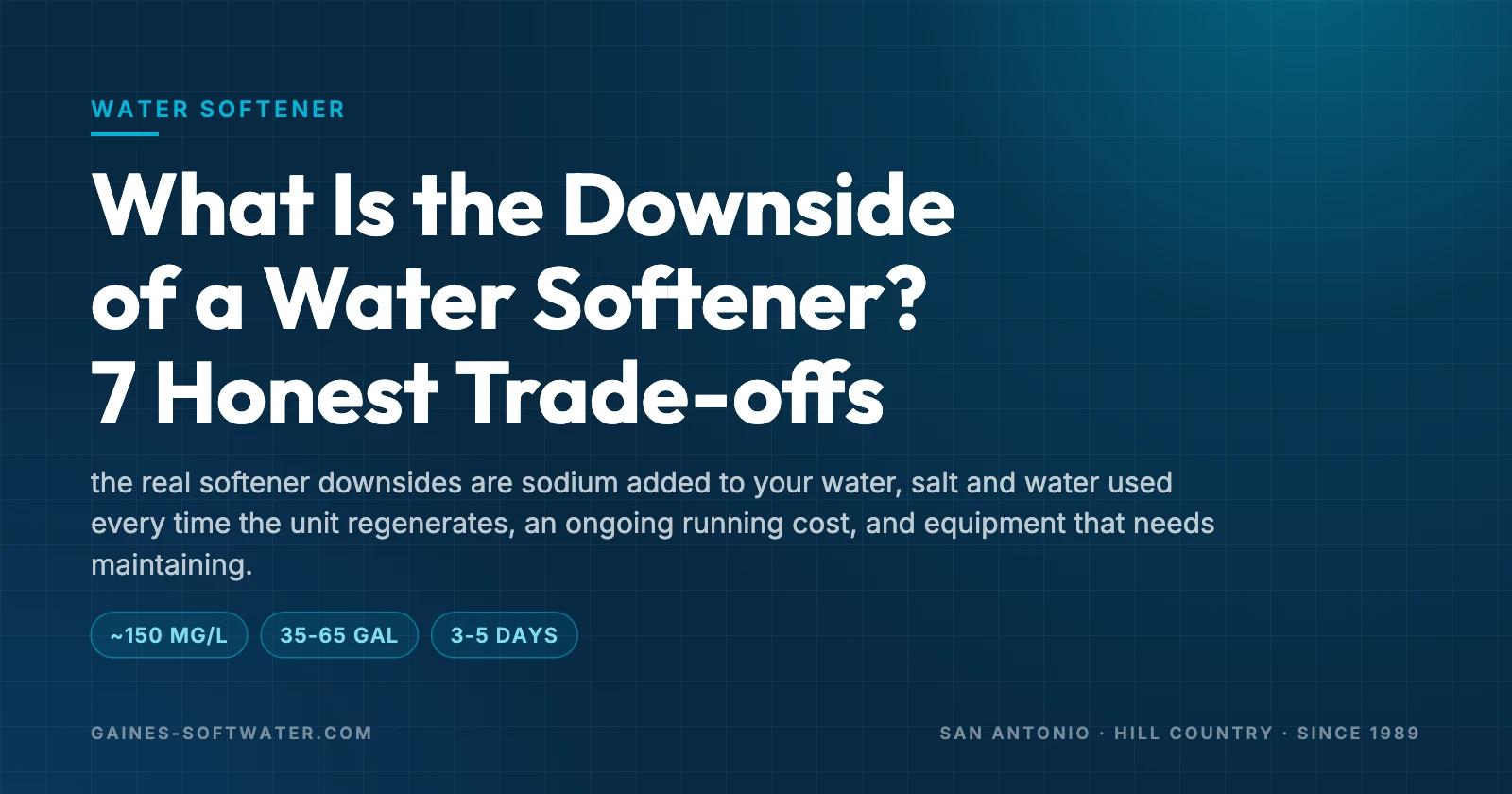
Short answer: the real softener downsides are sodium added to your water, salt and water used every time the unit regenerates, an ongoing running cost, and equipment that needs maintaining. None of them are hidden, and on Hill Country water most households still come out ahead. You should know all of them before you buy.
What this guide covers
- It adds sodium to your water
- It uses water and salt to clean itself
- There is a running cost nobody mentions in the showroom
- It changes how the water tastes
- The slippery feel takes getting used to
- The discharge has to go somewhere legal
- It is equipment, so it needs looking after
- The upfront cost is real
- What a softener does not fix
- When the trade is still worth making
- Frequently asked questions
It adds sodium to your water
Ion exchange works by swapping calcium and magnesium for sodium, so softened water carries more sodium than it did. The amount is proportional to how hard your water was to begin with, and it heads most lists of softener downsides.
On water testing around twenty grains per gallon, that works out at roughly a hundred and fifty milligrams of sodium per litre. For context, that is comparable to a slice of bread, and well below a portion of most tinned soup.
For the majority of people this is not significant. If anyone in the house is on a medically restricted sodium intake, it is worth raising with their doctor, and potassium chloride can be used in place of salt. Of all the softener downsides, this is the one most often overstated and least often quantified.
It uses water and salt to clean itself
A softener regenerates by flushing the resin bed with brine and rinsing it to drain. Depending on size and efficiency, that typically uses somewhere between thirty-five and sixty-five gallons each time.
Sized correctly, a household unit regenerates every three to five days rather than daily, so the annual figure is smaller than people expect. Sized badly, it can run every day, and that is when the softener downsides start to bite.
This is one of the softener downsides that good specification genuinely reduces. Metered valves regenerate on actual water use rather than a timer, which is why we fit them as standard.
- ~150 mg/Lsodium added at 20 grains per gallon hardness
- 35-65 galwater used per regeneration cycle
- 3-5 daysregeneration interval when correctly sized
- 10-15 yrsresin life on clean municipal water

There is a running cost nobody mentions in the showroom
Salt is the main consumable, and a typical Hill Country household gets through several bags a month depending on hardness and water use. Somebody has to buy it and carry it, which is among the most practical softener downsides.
Resin lasts roughly ten to fifteen years on clean municipal water and considerably less where iron is reaching it untreated. Valves need occasional parts. None of it is expensive, but it is not nothing.
When people list softener downsides after living with a system, the salt run is usually top of the list. Delivery services exist precisely because carrying forty pound bags gets old.
- 1Test before you buyHardness, iron and clarity decide whether a softener is even the right purchase.
- 2Size it properlyCorrect capacity cuts salt use, water use and wear at the same time.
- 3Plan the drainConfirm the discharge route, particularly on septic systems.
- 4Decide on drinking waterFit a bypass tap or reverse osmosis while the installer is on site.
It changes how the water tastes
Calcium and magnesium contribute to what most people think of as fresh tasting water. Take them out and some households find softened water tastes flat or faintly salty, one of the softener downsides that surprises people.
This is subjective and many people never notice. Those who do usually keep one unsoftened tap at the kitchen sink, or fit reverse osmosis for drinking and cooking, which strips the dissolved solids and resets the taste entirely.
It is worth deciding this before installation rather than after, because plumbing in a bypass tap is far easier while the fitter is already there.
| Downside | How serious | What reduces it |
|---|---|---|
| Sodium added | Minor for most, worth checking on restricted diets | Potassium chloride, or a bypass tap for drinking |
| Regeneration water | Moderate if undersized | Metered valve, correct capacity |
| Salt cost and hauling | Ongoing and unavoidable | Efficient unit, delivery service |
| Flat taste | Subjective | Unsoftened kitchen tap or reverse osmosis |
| Slippery feel | Temporary for most | Time, and a lower soap dose |
| Brine discharge rules | Decisive on some rural sites | Check locally, or use a salt-free conditioner |
The slippery feel takes getting used to
Almost everyone notices this in the first week, and it is the softener downsides preview nobody warns you about. Soap lathers freely and rinses off completely, which feels slippery compared with hard water where soap scum is left behind on your skin.
Nothing is being left on you. The sensation is the absence of the residue you were used to, not the presence of something new, though it takes a fortnight to stop feeling odd.
Most people adjust and then find hard water unpleasant when they travel. It belongs on any honest list of softener downsides all the same, because it does bother a minority permanently.
The discharge has to go somewhere legal
Regeneration produces brine that has to reach a drain. In town that is straightforward and none of the usual softener downsides apply. On a property with a septic system it needs thought, and some jurisdictions place conditions on brine discharge.
Septic systems generally tolerate softener discharge, but the drain field, the tank size and local rules all matter. This is worth confirming rather than assuming, and it is a genuine constraint rather than a scare story.
For a small number of rural properties this is one of the softener downsides that decides the outcome, and a salt-free conditioner becomes the more practical answer.

It is equipment, so it needs looking after
A softener is a mechanical device with a control valve, a resin bed and a brine tank. Salt bridges form, injectors block, and valves eventually wear, which is where mechanical softener downsides come from.
Annual service keeps most of that from becoming a failure. Ignore it for five years and the unit will let you know, usually by quietly stopping while continuing to consume salt.
Households who expect an appliance they never touch are the ones most disappointed. Setting that expectation properly removes most of the sting from these softener downsides.
The upfront cost is real
A properly sized, professionally installed system is a meaningful purchase, and on a well needing iron or sediment pre-treatment the figure climbs further.
Against that sits scale that no longer forms in the water heater, appliances that last closer to their design life, and noticeably less soap, shampoo and detergent. The payback is real, but measured in years rather than months, which is why cost sits on every list of softener downsides.
Anyone comparing a cheap online unit against a fitted system should compare like for like, including sizing, installation and who returns your call in year six.
What a softener does not fix
Softening removes hardness and nothing else, and misunderstanding that creates avoidable softener downsides. It does not remove bacteria, nitrate, arsenic, chlorine taste or sediment, and it will not make unsafe water safe.
On a private well that distinction matters enormously, because the softener is only one stage in a sequence that should start with a test and, where needed, sediment and iron removal.
Buying a softener expecting it to solve a taste or a health concern is the most expensive of the softener downsides, because you have spent the money and not addressed the problem.
When the trade is still worth making
Most of this region tests between fifteen and twenty-five grains per gallon. At that hardness, scale is not a theoretical risk, it is already happening inside your water heater.
Weighed against that, the softener downsides above are mostly manageable: sized properly, serviced annually, with a bypass tap for drinking water if you want one.
The households who regret it, and who list the most softener downsides afterwards, are almost always the ones who bought without a test. The ones who are glad are the ones who knew exactly what they were trading away.
Frequently asked questions
What is the biggest downside of a water softener?
The ongoing running cost. Salt has to be bought and carried, and the unit needs annual service. Everything else on the list of softener downsides is either minor or fixable at installation.
Is softened water bad for you?
For most people no. It contains more sodium than hard water, roughly comparable to a slice of bread per litre at typical Hill Country hardness. Anyone on a restricted sodium intake should raise it with their doctor.
Does a water softener waste a lot of water?
A correctly sized unit uses thirty-five to sixty-five gallons every three to five days. An undersized one can regenerate daily, which is where the waste complaints come from.
Can I drink softened water?
Yes, though some people dislike the flatter taste. Many households keep one unsoftened kitchen tap or fit reverse osmosis for drinking and cooking.
Will a softener fix my well water?
Only the hardness. It does not remove bacteria, nitrate, arsenic or sediment, so on a well it is one stage in a sequence rather than a complete answer.
Know the trade-offs before you spend anything
We test on site for free across Boerne, Kerrville, Fredericksburg, New Braunfels, Canyon Lake and the wider Hill Country. You get the numbers in writing, with no obligation to buy anything.
Related reading: water softeners, salt-free water softeners, reverse osmosis systems and free water testing.
More from this guide: which brand is actually best, what a softener costs and the signs of hard water.
Sources: Water Quality Association, Texas Well Owner Network (Texas A&M AgriLife), EPA drinking water regulations.