Short answer: Well water safety comes down to one uncomfortable fact: nobody is checking it for you. Public systems are sampled and reported by law. Private well water is checked only when the owner arranges it, and most owners have not arranged it in years.
What this guide covers
The oversight gap
Texas regulates public water systems closely. Private wells sit outside that framework almost entirely.
There is no annual report, no routine sampling and no requirement that anyone tell you when your well water changes.
Well water safety is therefore an owner responsibility rather than a service you receive, and that is the single most useful thing to understand about it.
- Unregulatedprivate wells are not sampled or reported in Texas
- Annuallyminimum testing interval for a private well
- Coliformthe most commonly failed test on Texas wells
- Freeon-site testing across the Hill Country, no obligation
Bacteria, the result that matters most
Coliform is the most commonly failed test on Texas private wells. Its presence indicates a pathway between the surface and your well water.
E. coli specifically indicates faecal contamination and should be treated as urgent rather than as a maintenance item.
A positive result should be retested and the wellhead inspected, because the cause is frequently a cracked casing, a poor seal or surface pooling rather than the aquifer.

Nitrate and agricultural country
Nitrate moves easily through soil and turns up near fertiliser use, septic fields and livestock operations, all of which are common across the Hill Country.
It is colourless, tasteless and odourless, so nothing about the well water warns you. Only a test does.
It matters most for infants and pregnant women, which is why it belongs on any well water safety check for a household with young children.
- 1InspectCasing, cap, seal and ground slope checked at the wellhead.
- 2TestBacteria, nitrate, hardness, iron and pH measured on site.
- 3TreatStages specified in the order that protects each component.
- 4RetestChecked again annually and after any change in the water.
Iron, manganese and arsenic
Iron and manganese are nuisance contaminants. They stain fixtures and laundry and foul softener resin, but they are not health hazards at typical concentrations.
Arsenic occurs naturally in some Texas formations and is a genuine health concern. It has no taste or smell at all.
The distinction matters, because it decides whether you are solving an annoyance or a risk, and the two justify very different budgets.
| Contaminant | Health or nuisance | How it is treated |
|---|---|---|
| Coliform bacteria | Health | Ultraviolet after clarification |
| E. coli | Health, urgent | Disinfection plus wellhead repair |
| Nitrate | Health, infants especially | Reverse osmosis or specific media |
| Arsenic | Health | Reverse osmosis or adsorptive media |
| Iron and manganese | Nuisance | Oxidising or catalytic filtration |
| Hardness | Nuisance | Ion-exchange softening |
When to test
Annually as a baseline, covering bacteria, nitrate, hardness, iron and pH.
Immediately after any change in well water taste, smell, colour or clarity, and after flooding or heavy rain near the wellhead.
Also on buying a property with a well, before closing rather than after, and after any work on the well, pump or pressure tank.
The wellhead itself
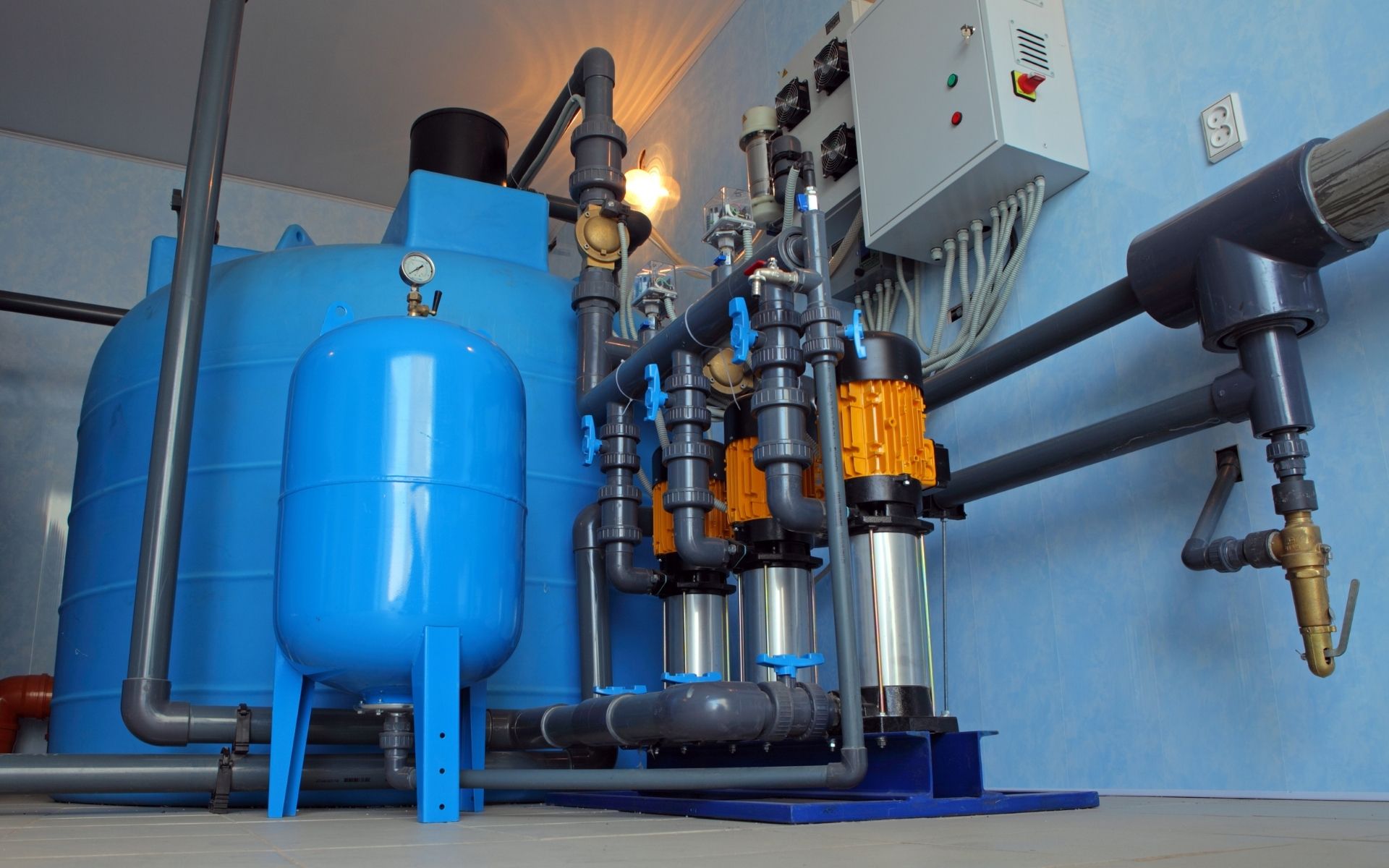
Protecting well water is mechanical as much as chemical, and a great deal of it rather than chemical. The casing should stand clear of the ground and the cap should be sealed and vermin-proof.
Ground around the head should slope away so rain runs off rather than pooling and finding a path down the outside of the casing.
Septic fields, livestock pens and chemical storage all need distance from the head, and existing setbacks are worth confirming rather than assuming.
Treating what the test finds
Bacteria in well water are handled by ultraviolet disinfection, which adds nothing to the water but needs good clarity upstream to work.
Nitrate and arsenic are handled by reverse osmosis at the point of use, or by specific media where whole-house treatment is required.
Hardness, iron and sulfur are nuisance problems with well established answers, taken in the order that protects each stage.

The order that makes treatment work
Sediment first, then iron and sulfur, then softening, then disinfection, then drinking-water polishing.
Ultraviolet placed ahead of well water clarification is a common and expensive error, because suspended particles shadow the bacteria and the lamp cannot reach them.
How we help
We test well water on site free of charge across Boerne, Kerrville, Fredericksburg, New Braunfels, Canyon Lake, Bandera and San Antonio.
Where a result needs a certified laboratory rather than a field kit, we say so and tell you where to send it.
A fair share of visits end with us confirming the well water is fine and recommending nothing at all, which is the point of testing first.
Frequently asked questions
Who checks well water safety in Texas?
Nobody, unless the owner arranges it. Private wells sit outside the regulatory framework that covers public systems.
How often should I test my well?
Annually at minimum, and immediately after any change in taste, smell or colour, or after flooding near the wellhead.
What should a basic test cover?
Bacteria, nitrate, hardness, iron and pH. Add arsenic where local geology or a previous result suggests it.
My water looks and tastes fine. Is that enough?
No. Nitrate, arsenic and bacteria are all colourless, tasteless and odourless. Only a test tells you.
What do I do about a positive bacteria result?
Retest to confirm, inspect the wellhead for surface intrusion, and use an alternative supply for drinking until it is resolved.
Book a free well water safety test
We test on site for free across Boerne, Kerrville, Fredericksburg, New Braunfels, Canyon Lake and the wider Hill Country. You get the numbers in writing, with no obligation.
Related reading: well water services, water testing and analysis, water filtration systems, reverse osmosis systems.
More from this guide: what a water test measures, well water treatment in order and well water purification. Also worth reading: hard water solutions for well water.
Sources and further reading: Texas Well Owner Network (Texas A&M AgriLife), EPA national primary drinking water regulations, Texas Water Development Board groundwater data.