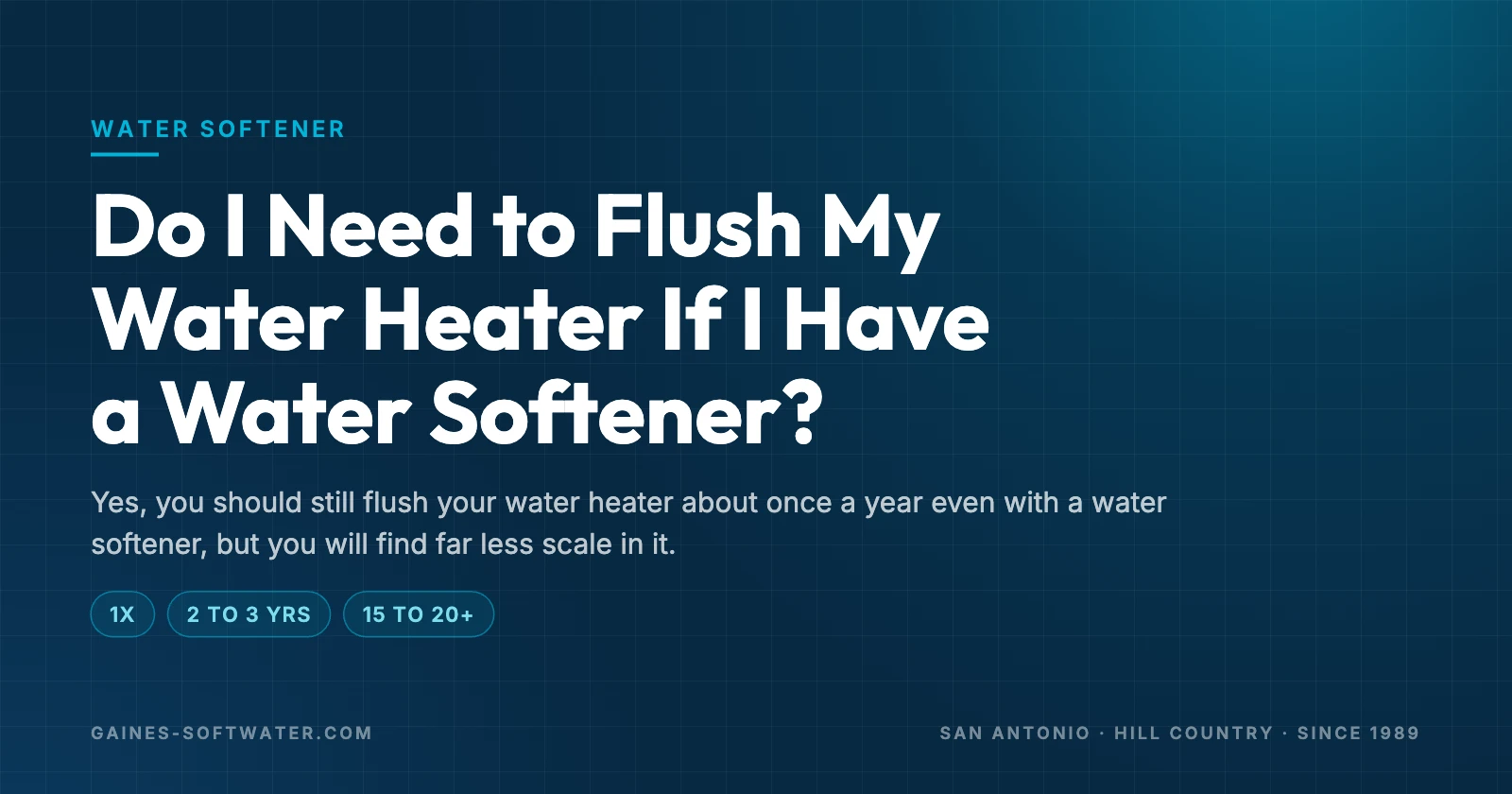
Short answer: Yes, you should still flush your water heater about once a year even with a water softener, but you will find far less scale in it. A softener stops most new hardness minerals from reaching the tank, yet sediment and scale that built up before the softener went in stay put until you drain them. Check the anode rod every 2 to 3 years, and if you have a tankless unit, plan to descale it less often rather than never.
What this guide covers
- The short version for busy homeowners
- What hard water does to a tank water heater
- How to flush a tank water heater
- Tankless units and hard water
- Why you still flush with a softener
- Anode rods and softened water
- How often to descale a tankless unit
- Warning signs worth checking
- When to call a plumber
- Getting a real answer for your house
- Frequently asked questions
The short version for busy homeowners
A softener changes how much maintenance your water heater needs, not whether it needs any. Softened water carries very little calcium and magnesium, so the crust that normally builds on the bottom of a tank or inside a heat exchanger grows far more slowly.
Annual water heater flushing is still the safe habit. Tanks collect sand, grit and bits of old scale from the plumbing, and none of that is hardness the softener can remove. A yearly drain takes under an hour.
San Antonio and Hill Country water is hard, commonly 15 to 20+ grains per gallon, so the difference shows when you open the drain valve. Our guide to hard water in San Antonio covers where that hardness comes from.
What hard water does to a tank water heater
When hard water is heated, dissolved minerals come out of solution and settle as scale. In a gas tank, that layer forms on the bottom right above the burner. In an electric tank, it coats the heating elements and piles up around the lower one.
The first sign is usually noise. Water trapped under the scale layer boils in small pockets and makes a popping or rumbling sound as the burner fires. It tells you the tank is working harder than it should.
Over time that extra work shows up as slower recovery, higher gas or electric use, burned-out elements and a shorter life overall. The U.S. Department of Energy notes that sediment buildup reduces efficiency and recommends periodic draining as basic upkeep. A tank that should last a decade can fail years early on very hard water.
- 1xflush per year, softener or not
- 2 to 3 yrsbetween anode rod checks
- 15 to 20+gpg typical local hardness
- 0 to 1gpg from a working softener
How to flush a tank water heater
A basic flush is a reasonable job for a handy homeowner, as long as you respect the heat and pressure involved. The goal is to drain enough water through the bottom valve to carry out loose sediment, then refill the tank before the heat comes back on. Read your owner’s manual first.
Safety comes first. Turn the gas control to pilot or off, or switch off the breaker for an electric unit. Then let the water cool for a few hours. Water in a tank set to 120°F or higher can scald, and an empty electric tank with power on will burn out its elements.
The steps below are a general outline, not a substitute for your manufacturer’s instructions. If the drain valve is plastic, brittle or crusted shut, stop and get help rather than forcing it.
- 1Shut offTurn the gas to pilot or off, or switch off the breaker, and let the water cool.
- 2ConnectClose the cold supply valve and run a garden hose from the drain valve to a floor drain or outside.
- 3DrainOpen a hot tap nearby, open the drain valve and let it run until the water comes out clear.
- 4RefillClose the drain, open the cold supply, wait for hot taps to run steady, then restore power or gas.
Tankless units and hard water
A tankless water heater has no tank for sediment to settle in, but it has a heat exchanger with narrow passages that scale can narrow quickly. As minerals coat the inside, flow drops and the unit has to work harder to reach the set temperature. Many models then throw a scale or overheat error code.
Because of that, many tankless manufacturers either require or strongly recommend water treatment above a certain hardness level, and some tie warranty coverage to it. The threshold varies by brand, so check your manual or warranty card.
On untreated San Antonio water, tankless owners are often told to descale once a year or more. With a softener feeding the unit, that interval usually stretches out a long way.
| Task | On hard water | On softened water |
|---|---|---|
| Tank flush | Yearly, often heavy sediment | Yearly, usually light sediment |
| Electric element check | Frequent scale on elements | Far less buildup |
| Anode rod check | Every 3 to 5 years | Every 2 to 3 years |
| Tankless descale | Yearly or more often | Less often, per manual |
| Inlet screen cleaning | Yearly | Yearly |
| Rumbling or popping | Common as scale builds | Rare once old scale is cleared |
Why you still flush with a softener
The first reason is history. If your water heater ran on hard water for even a year or two before the softener was installed, there is likely a layer of old scale and loose flakes in the bottom. Draining is how it leaves.
The second reason is sediment that has nothing to do with hardness. Sand and grit from the supply line, small bits of pipe scale knocked loose during repairs, and debris from a well can all settle in a tank. A softener is not a sediment filter.
The third reason is simply knowing the condition of your system. Lots of white chips means old scale is still breaking loose, which is normal for the first few flushes.
Anode rods and softened water
Most tank-style water heater models have a sacrificial anode rod, usually magnesium or aluminum, that corrodes so the steel tank does not. When the rod is used up, the tank itself starts to rust from the inside.
Softened water is more conductive than hard water, and it lacks the thin mineral layer that can partly coat a rod. For those reasons, many plumbers find that anodes can wear faster on softened water, though how much faster depends on the water, the rod material and how the softener is set. It is a reason to check sooner, not a reason to skip the softener.
A sensible plan is to pull and inspect the anode every 2 to 3 years. If it is down to bare wire or less than about half its original thickness, replace it. A new rod costs far less than a new water heater.

How often to descale a tankless unit
Descaling a tankless water heater means circulating a mild acid solution, often food-grade vinegar or a manufacturer-approved descaler, through the heat exchanger with a small pump and isolation valves.
On hard local water without treatment, a yearly descale is a common minimum, and heavy users may need it more often. With softened water, many owners can stretch that to every couple of years, but follow your manufacturer’s schedule and watch for error codes or a drop in hot water flow as signals to do it sooner.
Clean the inlet water screen too, since it can clog regardless of hardness. Our guide to softener regeneration explains how a softener keeps water consistently soft.
Warning signs worth checking
Rumbling, popping or crackling from a tank water heater is the classic sign of scale or sediment on the bottom. A tankless water heater that shows an error code or fluctuates in temperature may have restricted flow through the exchanger.
Other clues: hot water that runs out sooner than it used to, longer recovery times, rusty or smelly hot water, and rising energy bills can all point to a heater that needs attention.
Look at your softener as well. If you start seeing spots on glasses and crust on faucets again, the softener may be out of salt or overdue for service, and your heater is back on hard water. Our post on how long water softeners last covers what wears out and when.

When to call a plumber
Some jobs are better left to a licensed plumber. Call one if the drain valve will not open or close, if water leaks from the tank body, or if the temperature and pressure relief valve drips or discharges. A leak from the tank itself usually means replacement, not repair.
A plumber is also the right call for gas control problems, a pilot that will not stay lit, a stuck anode rod, or any tankless unit that keeps showing errors after a descale.
If you are not comfortable around hot water, gas or wiring, pay for a yearly water heater service. Many plumbers will flush, check the anode and test the relief valve in one visit.
Getting a real answer for your house
How much protection your water heater gets depends on your actual hardness and whether your softener is sized and set correctly. An undersized softener, or one out of salt, lets hard water through.
A free on-site test tells you your raw hardness, what is coming out of your softener today and whether anything else in your water, such as iron on a well, needs attention. We put the numbers in writing so you can make your own decision.
Frequently asked questions
Do I need to flush my water heater if I have a water softener?
Yes, about once a year is still a good habit. A softener greatly reduces new scale, but sediment and old scale from before the softener still settle in the tank and need to be drained out.
Does a water softener help a water heater?
Yes. Removing calcium and magnesium means far less scale on the tank bottom, elements or heat exchanger, which helps efficiency and lifespan. It does not replace flushing or anode checks.
Does softened water damage anode rods?
Softened water can wear anode rods faster in many homes, though the effect varies. Checking the rod every 2 to 3 years and replacing it when worn keeps the tank protected.
How often should you descale a tankless water heater?
On untreated hard water, yearly or more often is common. With a softener, many units can go longer between descales, but follow the manufacturer’s schedule and watch for error codes.
How often should I flush my water heater?
Once a year works for most homes. On very hard untreated water or a well with sediment, every six months may be worth it. Check your owner’s manual for specific guidance.
Why is my water heater making a popping noise?
Popping or rumbling usually means scale or sediment on the tank bottom is trapping water that boils as the burner heats. A flush often helps, and a softener slows the buildup from coming back.
Find out what your heater is facing, free
We test on site for free across San Antonio, Boerne, New Braunfels, Canyon Lake and the wider Hill Country. You get the numbers in writing, with no obligation to buy anything.
Related reading: water softeners, hard water treatment, water treatment in San Antonio and free water testing.
More from this guide: which city in Texas has the hardest water, how long water softeners last and signs of hard water.
Sources: U.S. Department of Energy, Water Heating, USGS, Hardness of Water, Water Quality Association.