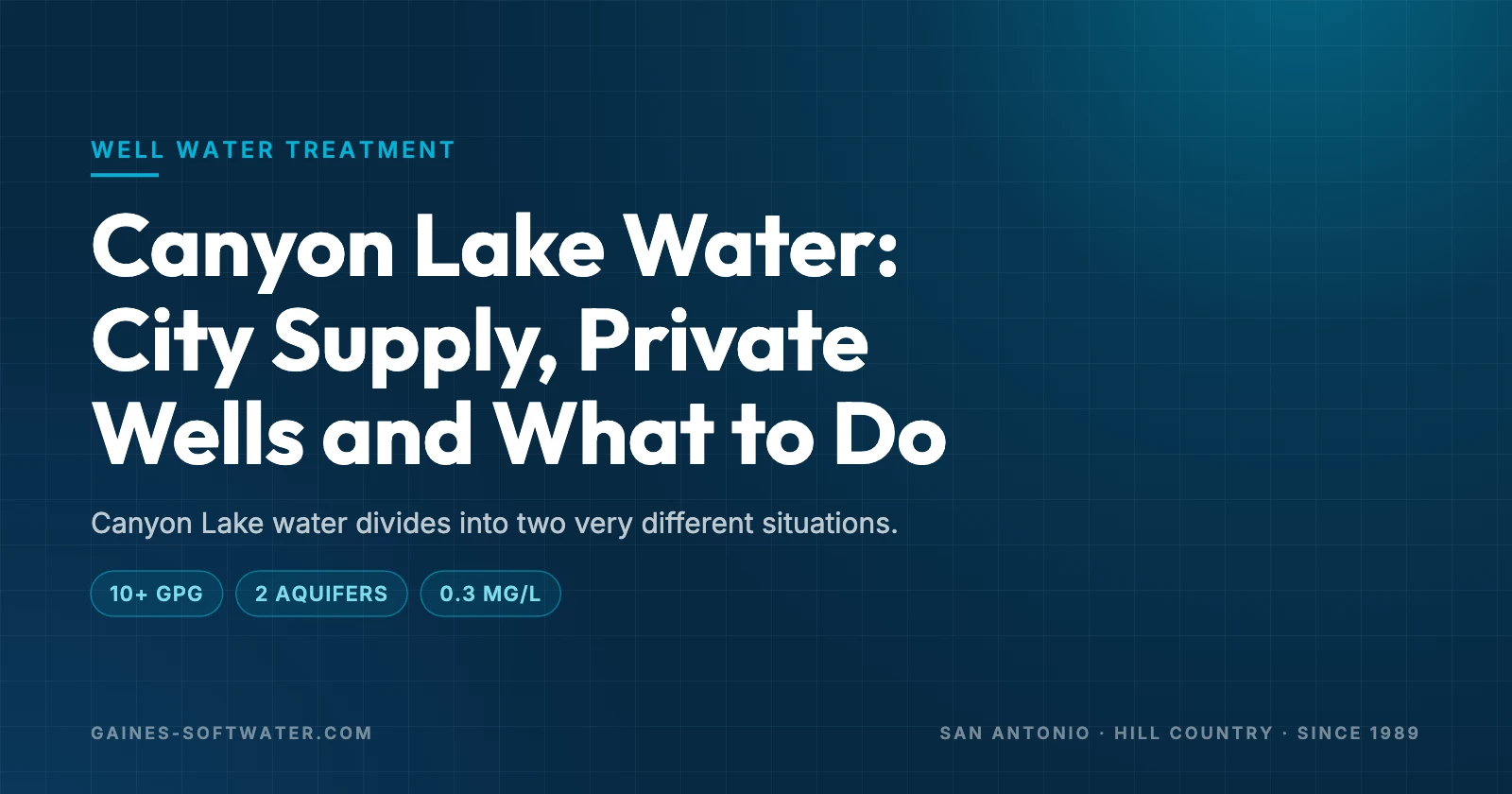
Short answer: Canyon Lake water divides into two very different situations. Homes on the municipal supply get treated water that is still hard. Properties on private wells around the lake get whatever the formation gives them, with nobody testing it unless the owner does.
What this guide covers
Two supplies, two conversations
Inside the served area, Canyon Lake water comes from a public system that is treated, monitored and reported. It is safe, and it is still hard.
Outside that area, and across a great deal of the surrounding Comal County countryside, households draw from private wells with no oversight of any kind.
Those two starting points lead to different equipment, which is why we test at the address rather than quoting from a map.
- 10+ gpgtypical hardness around Canyon Lake, classed very hard
- 2 aquifersEdwards and Trinity both feed this area
- 0.3 mg/Liron level that begins fouling softener resin
- 24/7emergency callout across Comal County
Hardness around the lake
The Edwards and Trinity aquifers both feed this area, and both move through limestone. That produces the calcium and magnesium we measure as hardness.
Readings here commonly land in the double digits in grains per gallon, which every published scale calls very hard.
Municipal treatment does not change it. Public systems make water safe rather than soft, so hardness reaches the tap exactly as it left the ground.
What wells around Canyon Lake carry
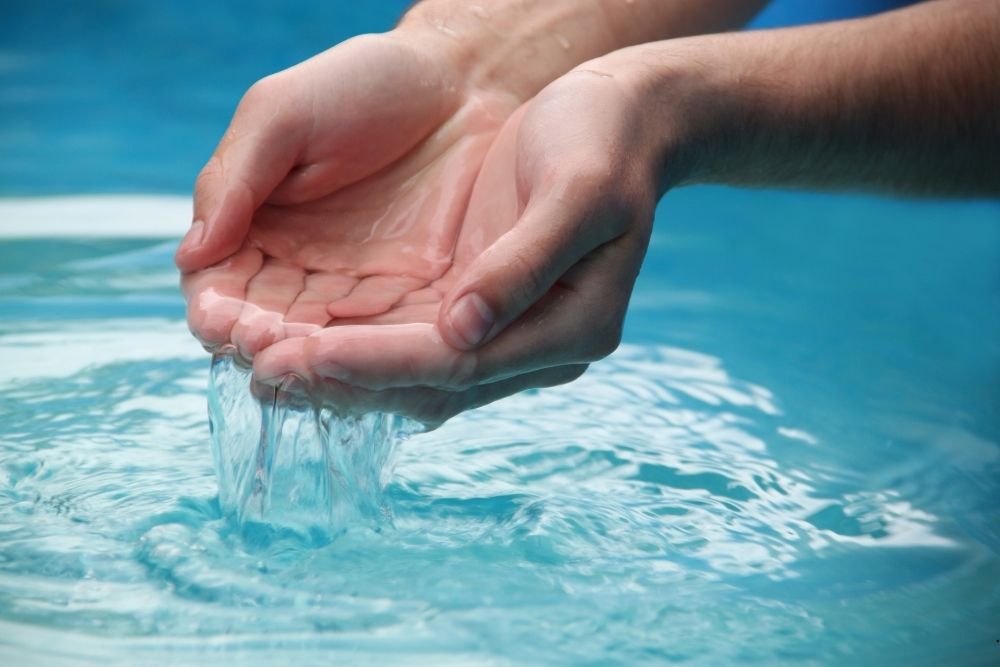
Iron is the most frequent finding, showing as orange staining in basins, on laundry and around fixtures.
Hydrogen sulfide turns up on a minority of wells and is unmistakable, producing the rotten egg smell. It is a dissolved gas, so a softener does nothing to it.
Sediment is seasonal. Wells in shallower formations and closer to the lake can pull fine grit for days after heavy rain.
- 1Free testHardness, iron, clarity and odour measured at your tap.
- 2SequenceOn a well, pre-treatment specified ahead of the softener.
- 3SizeCapacity matched to peak occupancy, not just the average week.
- 4ServiceScheduled maintenance on any brand, including inherited units.
Why lake levels matter to well owners
This area has swung between severe drought and heavy flooding within the same decade, and Canyon Lake water chemistry moves with it.
Drought concentrates dissolved minerals as the water table drops. Heavy rain does the opposite and can push surface contamination toward a wellhead.
That is why a test from five years ago is history rather than information, and why we retest at service visits.
| Canyon Lake supply | Common issue | What we fit |
|---|---|---|
| Municipal | Hardness in double digits | Correctly sized ion-exchange softener |
| Municipal | Chlorine taste | Whole-house carbon filtration |
| Private well | Orange staining | Iron filter ahead of the softener |
| Private well | Rotten egg odour | Aeration or catalytic carbon |
| Private well | Cloudy after rain | Spin-down and cartridge filtration |
| Rental or weekend home | Constant regeneration | Capacity sized to peak occupancy |
The order that protects your equipment
On a well the sequence is fixed: sediment, then iron and sulfur, then softening, then disinfection where bacteria are present.
Putting a softener ahead of iron removal is the most expensive mistake in well treatment, and it is the one we are called out to correct most often.
Sizing for lake-area households
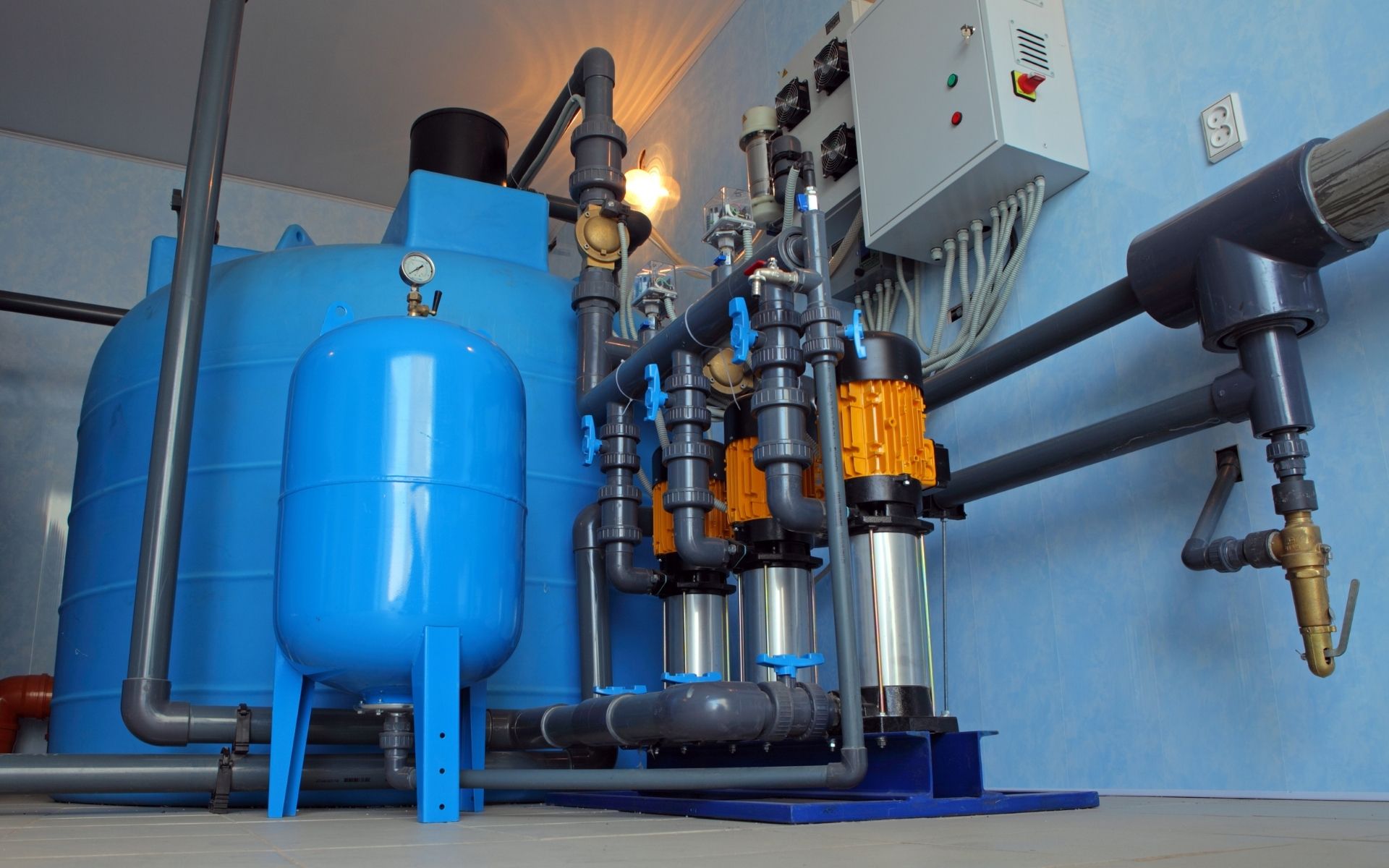
Capacity is arithmetic: household size, daily consumption and measured grains per gallon give the daily load, and the unit is chosen to regenerate every three to five days.
Weekend and rental properties around Canyon Lake need particular care, because occupancy spikes create demand a family-sized unit cannot meet.
Undersized units regenerate constantly and waste salt. Oversized ones cost more than the household needs.
Servicing what is already installed
A lot of equipment around the lake was fitted by firms that have since closed, leaving owners with no service history and no support.
We service every major brand, including systems we did not install, and we begin with a test rather than an assumption about the original specification.
Where a repair genuinely beats replacement we say so, and we carry common valve and control parts so most calls finish the same day.

When to call
Salt use rising without a change in household size usually means fouled resin or a valve that has stopped metering properly.
Water that feels hard again after years of being soft points at exhausted resin, and on a well that usually traces back to iron.
Any change in taste, smell or colour on a private well deserves a test first, because some of those results are health matters rather than nuisances.
Where we cover
We work across Canyon Lake, Startzville, Sattler, Spring Branch, Bulverde, New Braunfels and the wider Comal County area.
Emergency callout runs around the clock, because a leaking or bypassed system is a today problem.
Testing is free and carries no obligation, and a fair share of visits end with us recommending nothing at all.
Frequently asked questions
Is Canyon Lake water hard?
Yes. Readings around the lake commonly land in double digits in grains per gallon, which is classed as very hard.
I am on the municipal supply. Do I need a softener?
Usually yes. Public treatment makes water safe rather than soft, so hardness arrives at the tap unchanged.
We are on a well near the lake. Where do we start?
With a free test. Private wells are unregulated, so nothing has been checked unless you arranged it.
Does drought change my well water?
It can. Falling water tables concentrate dissolved minerals, and heavy rain can push surface contamination toward a wellhead.
Do you cover Startzville and Sattler?
Yes, along with Spring Branch, Bulverde, New Braunfels and the wider Comal County area.
Book a free water test at Canyon Lake
We test on site for free across Boerne, Kerrville, Fredericksburg, New Braunfels, Canyon Lake and the wider Hill Country. You get the numbers in writing, with no obligation.
Related reading: Canyon Lake water softeners, water softeners, well water services, free water testing.
More from this guide: San Antonio tap water, bottled water versus tap and sizing a softener in San Antonio. Also worth reading: water treatment options.
Sources and further reading: Texas Well Owner Network (Texas A&M AgriLife), EPA national primary drinking water regulations, Texas Water Development Board groundwater data.