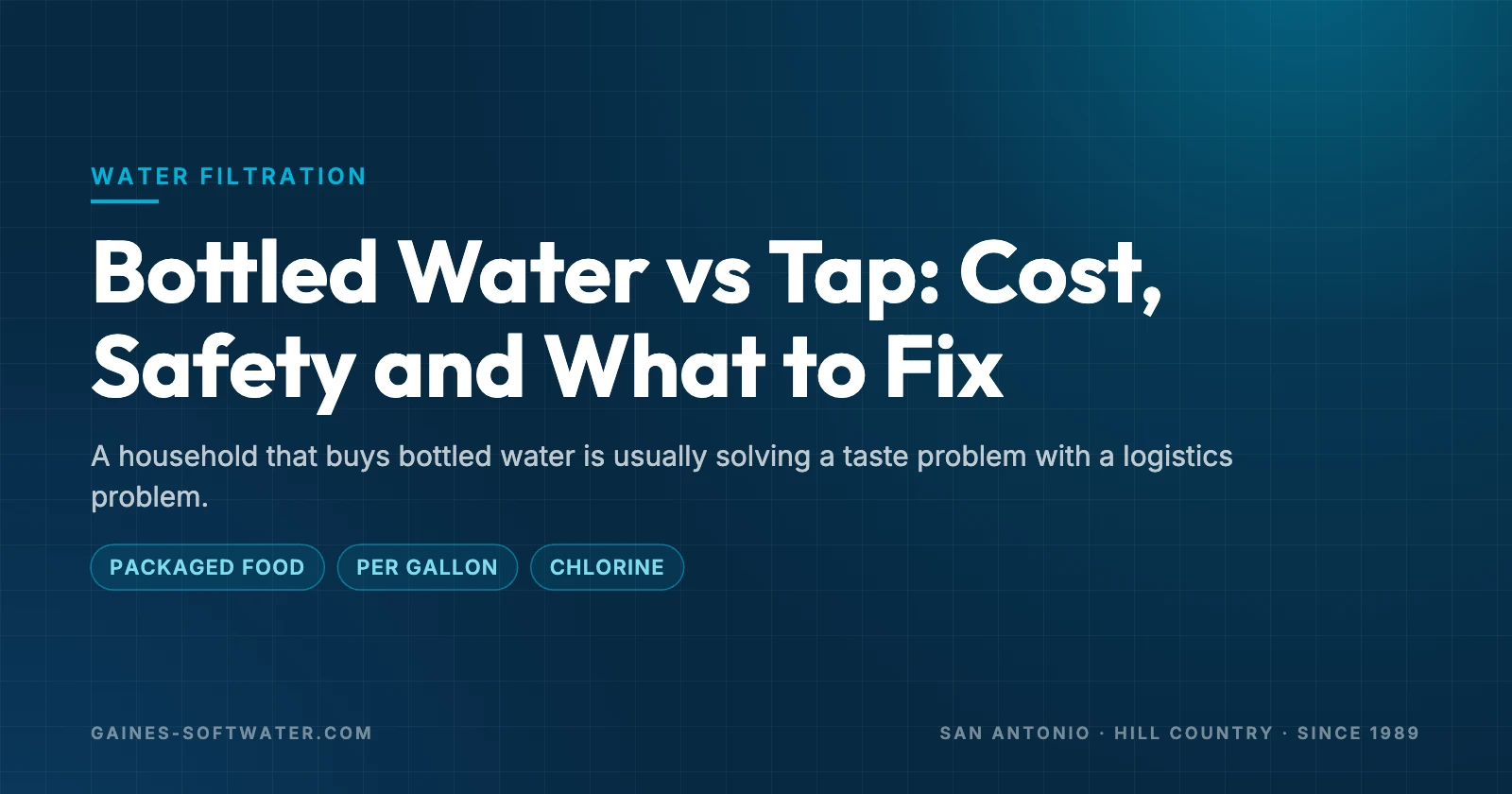
Short answer: A household that buys bottled water is usually solving a taste problem with a logistics problem. Bottled water is not held to stricter standards than tap, it costs orders of magnitude more per gallon, and the thing people actually object to is nearly always fixable at the sink.
What this guide covers
Who regulates bottled water
Bottled water is regulated as a packaged food, while public tap water is regulated as a utility with its own testing and reporting requirements.
The standards are broadly comparable rather than stricter, and public systems in Texas publish annual reports that anyone can read.
Bottled water producers are not required to publish equivalent results, so in many cases you know less about the bottle than about the tap.
- Packaged foodhow bottled water is regulated in the United States
- Per gallonbottled pricing, against dollars per thousand gallons from the tap
- Chlorinethe most common taste complaint, and the easiest to fix
- Freeon-site testing before you buy anything
Where bottled water comes from
A meaningful share of bottled water on shelves is treated municipal supply, sold under a brand rather than drawn from a spring.
Spring and mineral products do come from named sources, and their dissolved mineral content is what gives each brand a distinct taste.
Neither origin is inherently better. What matters is what has been done to the water, and that is a question you can answer at home too.

The cost difference is not marginal
Municipal tap water is priced in dollars per thousand gallons. Bottled water is priced in dollars per gallon.
A household drinking a few gallons a day is spending on packaging, transport and shelf space rather than on treatment.
A point-of-use filter at the kitchen sink brings the per-gallon figure back down to something close to the tap while addressing the taste complaint directly.
- 1TestFind out what is actually in your water rather than guessing.
- 2FilterCarbon at the tap for chlorine taste and odour.
- 3PolishReverse osmosis where dissolved solids are the complaint.
- 4Stop buyingRefill at home once the taste issue is solved.
What people are actually objecting to
In San Antonio and across the Hill Country the two usual complaints are chlorine smell and a hard, mineral mouthfeel.
Disinfectant residual is required by law to keep water safe through miles of distribution pipe, and it is the most common taste complaint we hear.
Neither issue is a safety failure. Both are entirely within specification, and both come off with the right filtration.
| Bottled water | Filtered tap water | |
|---|---|---|
| Regulation | Packaged food standards | Utility standards plus annual public reports |
| Cost per gallon | High | Very low after equipment |
| Chlorine taste | Absent | Removed by carbon filtration |
| Dissolved solids | Varies by brand | Removed by reverse osmosis |
| Availability | Requires buying and carrying | On tap, always |
| Waste | Single-use plastic | Reusable container |
Fixing it at the tap
Carbon filtration removes chlorine taste and odour and is the cheapest meaningful upgrade a household can make.
Reverse osmosis goes further, removing dissolved solids, nitrate, arsenic and lead, and it is what most closely reproduces the taste people buy bottles for.
Softening deals with scale rather than taste, but on hard water it protects everything downstream including a reverse osmosis membrane.
If you are on a private well
The calculation changes. Private wells are unregulated, so bottled water is a reasonable stopgap while a genuine problem is being diagnosed.
It is a poor permanent answer, because the same untreated water is still going through your shower, your laundry and your dishwasher.
A test first, then treatment, then no more bottles, is both cheaper and more thorough than buying water indefinitely.
Storage, plastic and shelf life
Bottled water stored warm, in a garage or a car, is stored badly, and taste degrades noticeably over time.
Single-use plastic also carries a waste cost that many households now weigh alongside the price per gallon.
Filtered water in a glass or steel container at home avoids both issues and is available without a trip to the shop.

When bottled genuinely makes sense
During a boil notice, after a positive bacteria result on a well, or while equipment is being installed or repaired.
For travel, or where no plumbing exists to filter, it is simply the practical option.
As a permanent household water supply for a home with working plumbing, it is an expensive way to avoid a solvable problem.
How we help
We test on site free of charge across Boerne, Kerrville, Fredericksburg, New Braunfels, Canyon Lake, Bandera and San Antonio.
The results tell you whether you are dealing with taste, hardness or something that genuinely needs treating.
A fair share of visits end with us recommending a simple carbon filter rather than anything larger.
Frequently asked questions
Is bottled water safer than tap water?
Not inherently. It is regulated as a packaged food, while public tap water is regulated as a utility with published annual reports.
Why does my tap water taste of chlorine?
A disinfectant residual required by law to keep water safe through the distribution system. Carbon filtration removes it.
What is the cheapest way to stop buying bottles?
A carbon filter at the kitchen tap if taste is the issue, or reverse osmosis if dissolved solids are.
I am on a well. Should I drink bottled?
As a stopgap while you get the water tested, yes. As a permanent answer it is expensive and leaves the rest of the house untreated.
Does a softener make water taste better?
Not directly. Softening removes hardness and protects appliances. Taste is a filtration question.
Book a free test before you buy another case
We test on site for free across Boerne, Kerrville, Fredericksburg, New Braunfels, Canyon Lake and the wider Hill Country. You get the numbers in writing, with no obligation.
Related reading: reverse osmosis systems, water filtration systems, free water testing, water softeners.
More from this guide: sizing a softener in San Antonio, softener service in New Braunfels and softeners in Fredericksburg.
Sources and further reading: Texas Well Owner Network (Texas A&M AgriLife), EPA national primary drinking water regulations, Texas Water Development Board groundwater data.