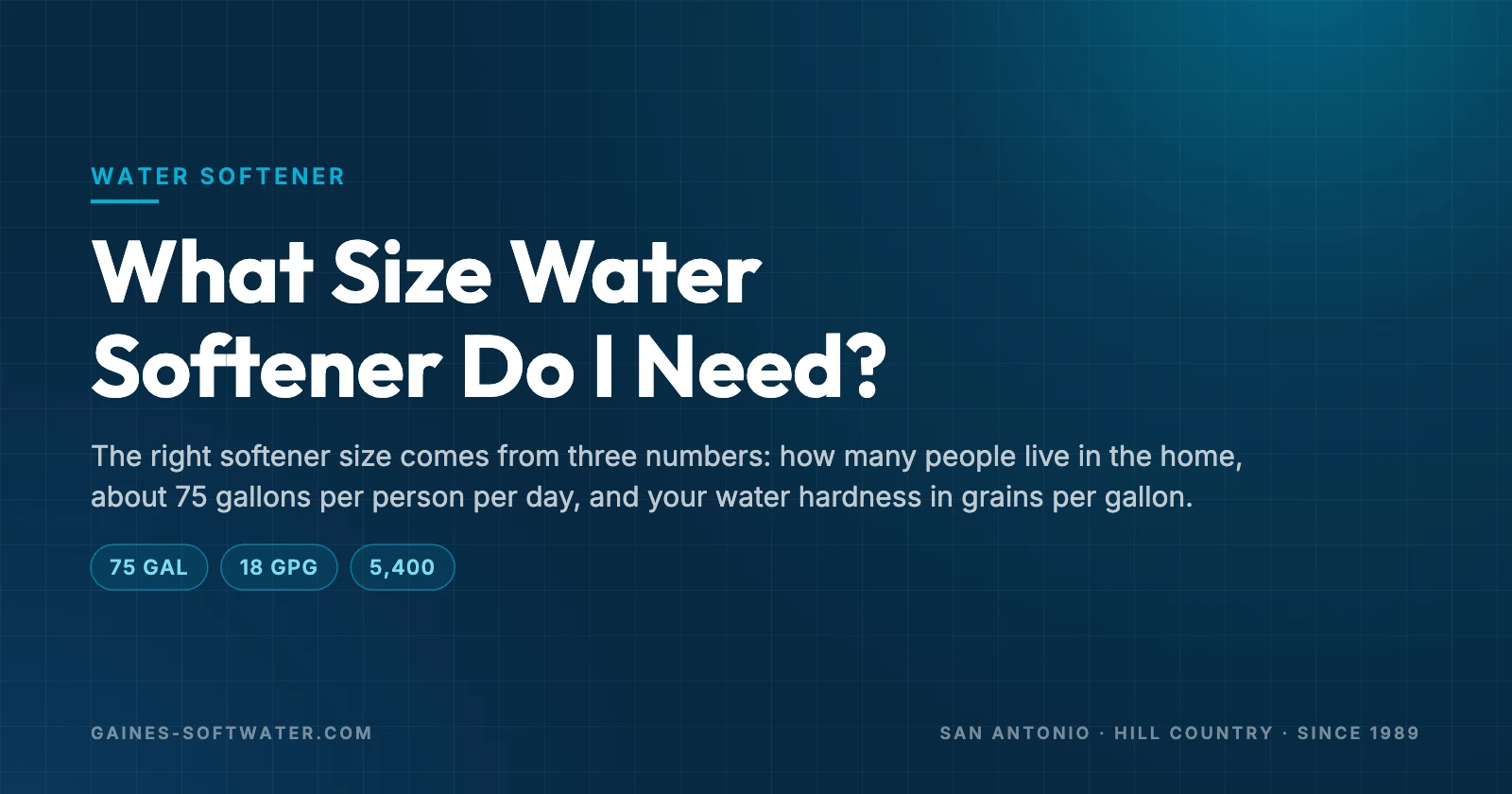
Short answer: The right softener size comes from three numbers: how many people live in the home, about 75 gallons per person per day, and your water hardness in grains per gallon. Multiply them to get your daily grain load, then pick a unit that regenerates every 3 to 7 days. For a typical 4-person, 3-bathroom San Antonio home at about 18 grains per gallon, that points to a 32,000 to 48,000 grain class. Bigger is not automatically better, and too small costs you more than you think.
What this guide covers
- The softener size math in one line
- Worked example: a 3-bathroom San Antonio home
- How to work out your own softener size
- Sizing table by household at about 18 gpg
- Why bathrooms are only a rough proxy
- Flow rate and service flow for bigger homes
- Is it bad to buy too big?
- What happens when a softener is too small
- Well water, iron and other things that change the answer
- Getting a real softener size for your house
- Frequently asked questions
The softener size math in one line
Sizing a water softener is mostly arithmetic. Take the number of people in the home, multiply by about 75 gallons per person per day, then multiply by your hardness in grains per gallon (gpg). The result is your daily grain load: the amount of hardness the resin has to pull out of your water every day.
A well chosen system regenerates every 3 to 7 days. Multiply your daily grain load by that number of days and you have the capacity you need between cycles. That figure, not the number on the box, sets your softener size.
Worked example: a 3-bathroom San Antonio home
Say you have four people in a 3-bathroom house on SAWS city water. Hill Country and San Antonio water is hard, commonly 15 to 20+ grains per gallon, so 18 gpg is a fair working number. Four people times 75 gallons is 300 gallons a day. Three hundred gallons times 18 gpg is 5,400 grains of hardness every day.
Over a 7-day cycle that is about 37,800 grains. Over 5 days it is 27,000. So you want a unit that delivers roughly 27,000 to 38,000 grains between regenerations, plus a little reserve.
Here is the catch most people miss. A softener sold as “48,000 grains” only reaches that number at its highest salt setting. At an efficient salt dose, the same tank might deliver closer to 30,000 to 34,000 grains. That is why this household lands in the 32,000 to 48,000 grain class, and why the right softener size depends on how the valve is programmed as much as on the label.
- 75 galtypical use per person per day
- 18 gpgworking hardness for San Antonio
- 5,400grains per day, family of four
- 3 to 7days between regenerations

How to work out your own softener size
The only number you may not know for softener size is your hardness. City customers can find a range in their utility’s annual water quality report, but the most reliable number comes from testing your own tap.
When you are done, compare your number to the unit’s capacity at a moderate salt setting, not its maximum. If a salesperson only quotes the maximum, ask what the unit delivers at 6 to 8 pounds of salt per cubic foot of resin. That answer tells you far more about real softener size than a big number on a sticker.
- 1TestFind your hardness in grains per gallon, and check for iron if you are on a well.
- 2CountMultiply the people in the home by about 75 gallons, or use your real daily usage.
- 3MultiplyGallons per day times grains per gallon gives your daily grain load.
- 4PickChoose a unit that covers 3 to 7 days of that load at an efficient salt setting.
Sizing table by household at about 18 gpg
The table below uses 75 gallons per person per day and 18 grains per gallon, a typical working figure for San Antonio and much of the Hill Country. Treat it as a starting softener size, not a final answer. If your water tests harder, or your family uses more water, move up a row.
The capacity class is the nominal rating on the unit. Usable capacity at an efficient salt setting is lower, which these suggestions already allow for. Very large households often do better with a twin-tank system.
| People in home | Daily grain load at 18 gpg | Typical capacity class |
|---|---|---|
| 1 to 2 | 1,350 to 2,700 grains | 24,000 grain |
| 3 | about 4,050 grains | 32,000 grain |
| 4 | about 5,400 grains | 32,000 to 48,000 grain |
| 5 | about 6,750 grains | 48,000 grain |
| 6 | about 8,100 grains | 48,000 to 64,000 grain |
| 7 or more | 9,450 grains and up | 64,000 grain or twin-tank |
Why bathrooms are only a rough proxy
Many quotes start with “how many bathrooms?” because more bathrooms usually means more people. But the softener does not care how many toilets you own. It cares how many gallons pass through it and how hard those gallons are.
A retired couple in a 3-bathroom house might use 150 gallons a day. A family of six in the same house could use 450. Same bathrooms, three times the grain load.
Bathrooms do matter for one thing: flow rate. More bathrooms means more fixtures that can run at the same time. So use people and hardness to set capacity, and use bathrooms and fixtures to check flow. That combination gets you to an honest softener size.
Flow rate and service flow for bigger homes
Capacity is how much hardness the unit can remove between cycles. Service flow is how many gallons per minute it can soften without letting hard water slip through or dropping your pressure. Bigger homes with several showers, a dishwasher and laundry running at once need both.
As a rough guide, a unit with 1 cubic foot of resin often handles around 7 to 9 gallons per minute, 1.5 cubic feet roughly 10 to 12, and 2 cubic feet a bit more. Valve size matters too. A 1 inch valve and plumbing generally move more water than 3/4 inch. Check the manufacturer’s service flow rating for the exact model.
With four or more bathrooms or a large tub, check softener size against flow: add up the fixtures that might run together. If that peak exceeds what the tank can handle, step up in resin volume or go twin-tank.

Is it bad to buy too big?
Honestly, a little oversized is fine and often smart. Going far too big is not. A modern demand-initiated valve can be set to a lower, more efficient salt dose, and a larger resin bed set that way uses less salt per grain removed than a small tank run at its maximum. That is a real benefit when the extra size is modest.
The problems start when a unit is so large it rarely regenerates. Water can cut narrow paths through a big, lightly used resin bed, called channeling, so some water passes through without being fully softened. Resin that sits for weeks between cycles can also grow stale, and chlorinated city water slowly wears resin over time. Most valves should be set to regenerate at least every 7 to 14 days regardless of usage.
Then there is the money. A unit two sizes too large costs more up front and uses more salt per regeneration. Our installation cost guide covers typical price ranges. The goal is the right softener size, not the biggest one in the showroom.
What happens when a softener is too small
A softener size that is too small has to regenerate constantly to keep up. You may see it cycling every day or even more than once a day. Each regeneration uses water and salt, so a small unit often ends up costing more to run than a correctly sized one, even though it was cheaper to buy.
The bigger problem is hard water breakthrough. If the resin runs out before the next cycle, hard water flows straight into your pipes and water heater. Spots, poor lather and scale come back.
Small units also have lower service flow, so pressure can drop. If your softener seems to be regenerating every night, a mismatch in softener size or settings is the first thing to check.

Well water, iron and other things that change the answer
Private wells in the Hill Country, often drawing from the Trinity Aquifer, can be harder than city water and may carry iron or manganese. Iron uses up resin capacity too. A common rule of thumb is to add a few grains per gallon to your hardness for each part per million of iron, which pushes the grain load and the right size up.
Heavy iron or sulfur usually needs pre-treatment, not just a bigger softener size. And if you have especially hard San Antonio water, run the math with your measured number, not an average.
Getting a real softener size for your house
The math above gets you close. A water test gets you the rest of the way. Hardness varies between neighborhoods and between wells on the same road, and iron changes what the system has to handle.
We test on site for free and run the sizing with your real hardness, your household size and your fixtures. You will get a recommended capacity, the salt setting it should run at and how often it should regenerate, in writing. If your current unit is already the right softener size and just needs adjusting, we will tell you that too.
Frequently asked questions
What size water softener do I need?
Multiply the people in your home by about 75 gallons a day, then by your hardness in grains per gallon. Pick a unit that covers 3 to 7 days of that load at an efficient salt setting. At San Antonio hardness, most families land between 32,000 and 48,000 grains.
How big of a water softener do I need for a 3 bathroom house?
It depends on the people, not the bathrooms. A 3-bathroom home with four people at 18 gpg uses about 5,400 grains a day, which points to the 32,000 to 48,000 grain class. Use the bathroom count to check flow rate, not capacity.
Is it bad to buy too big of a water softener?
Slightly oversized is fine and can save salt. Far too big is a problem: it regenerates too rarely, which can cause channeling and stale resin, and it costs more up front. A forced regeneration every 7 to 14 days helps.
How do I know if my water softener is too small?
It regenerates daily or more, you see hard water spots between cycles, or pressure drops when several fixtures run. Any of those suggests the softener size or the settings do not match your home.
Does a bigger water softener use more salt?
Not necessarily. A larger tank set to a moderate salt dose often uses less salt per grain of hardness removed than a small tank at maximum. It does use more salt per regeneration, but regenerates less often.
Does softener size change for well water?
Often, yes. Well water can be harder than city water and may contain iron, which uses up resin capacity. Test first, add for iron, and plan pre-treatment if iron or sulfur levels are high.
Get your softener sized right, free
We test on site for free across San Antonio, Boerne, New Braunfels, Canyon Lake and the wider Hill Country. You get the numbers in writing, with no obligation to buy anything.
Related reading: water softeners, water treatment in San Antonio, well water treatment and free water testing.
More from this guide: how often a softener should regenerate, how long a bag of softener salt lasts and what a water softener costs.
Sources: USGS, Hardness of Water, Water Quality Association, San Antonio Water System, Texas Well Owner Network.