
Short answer: A 40 lb bag of water softener salt lasts most San Antonio households somewhere between two and four weeks. With water at 15 to 20+ grains per gallon, a family of four on an efficient, demand-controlled unit often goes through roughly 1 to 2 bags a month. Older timer units, bigger families and high salt settings use more. If your usage suddenly jumps, that is a sign something needs a look, not a reason to buy more salt.
What this guide covers
- How long a 40 lb bag lasts
- What controls how fast you use water softener salt
- How to check and refill your brine tank
- Types of water softener salt compared
- What a 40 lb bag costs
- Can you put 2 bags in at once?
- Salt bridges and salt mushing
- Buying and storing salt
- When salt use spikes
- Getting a real number for your house
- Frequently asked questions
How long a 40 lb bag lasts
There is no single number, but ranges are useful. In San Antonio and the Hill Country, a 40 lb bag commonly lasts two to four weeks for a typical family home. A couple in a smaller house on an efficient unit might stretch a bag past a month.
A family of four on a modern demand-initiated softener often uses roughly 1 to 2 bags a month. The same family on an older timer unit that regenerates on a fixed schedule can easily use 3 or 4 bags, because that unit cleans itself whether it needs to or not. The difference is the control valve.
Treat any monthly figure as a starting point. Write down the date each time you add salt, and after two or three months you will have your own number, which beats any average.
What controls how fast you use water softener salt
Four things decide how fast a bag disappears. The first is hardness. Hill Country and San Antonio water is hard, commonly 15 to 20+ grains per gallon. The harder the water, the more often the resin fills up, and every regeneration draws on the brine tank.
The second is household size, at a common planning figure of about 75 gallons per person per day. The third is the salt setting: how many pounds the valve uses per cubic foot of resin. Higher settings squeeze out a little more capacity at a steep cost in salt.
The fourth is efficiency. Demand-initiated valves meter actual water use and regenerate only when the resin is close to exhausted. Timer valves regenerate on a calendar, ready or not. Our guide to how often a softener should regenerate explains why this is the biggest single lever on water softener salt use.
- 40 lbstandard bag size
- 1 to 2bags a month, typical efficient home
- 15 to 20+grains per gallon, local hardness
- 2 to 4bags most brine tanks hold
How to check and refill your brine tank
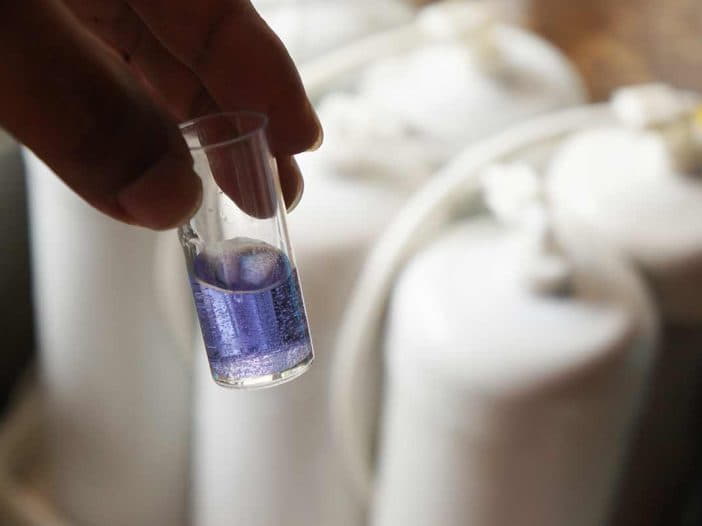
Checking softener salt takes less than a minute, and once a month suits most homes. Lift the brine tank lid and look. You want softener salt sitting above the water line, not water standing above the salt.
If you see a dry, flat crust, push gently on it with a broom handle. Loose salt underneath means you are fine. If the handle punches through into empty space, you have a salt bridge, covered below. Here is the routine we suggest.
- 1LookOpen the lid once a month and check that salt sits above the water.
- 2ProbePress gently on the surface with a broom handle to check for a hard crust.
- 3RefillAdd softener salt when the tank is about one third full, leaving a few inches of space at the top.
- 4RecordNote the date and number of bags so you can spot changes in usage early.
Types of water softener salt compared
You will see four main products. Evaporated pellets are the purest and most common pick. Solar crystals come from evaporating seawater in the sun, slightly less pure but cheaper. Rock salt is mined and carries more insoluble material. Potassium chloride does the same job without adding sodium.
For most San Antonio homes, high-purity pellets or solar crystals are the sensible choice. Rock salt leaves dirt that can clog the brine valve, so the savings often turn into a service call. Prices below are rough and vary by store and season.
| Salt type | Pros | Cons | Rough price per 40 lb bag |
|---|---|---|---|
| Evaporated pellets | Highest purity, very little residue, low bridging risk | Costs a little more than solar or rock | About $6 to $10 |
| Solar crystals | Good purity, widely available, good value | Slightly more residue; crystals can bridge in humid garages | About $6 to $9 |
| Rock salt | Cheapest per bag | Insoluble dirt builds up and can clog the brine valve | About $5 to $8 |
| Potassium chloride | No added sodium, a common choice for low-sodium diets | Much pricier, may need a higher setting to match salt | About $25 to $40+ |
| Rust or iron-fighting pellets | Includes an additive that helps with mild iron | Not a fix for real iron problems on well water | About $8 to $15 |
What a 40 lb bag costs
Most standard bags of water softener salt run roughly $6 to $15, depending on type, brand and store. Plain crystals and pellets sit toward the low end, specialty blends higher. Potassium chloride is in its own bracket, often three or four times the price.
At 1 to 2 bags a month, a typical efficient household spends something like $75 to $200 a year on softener salt. An older timer unit using 3 or 4 bags a month can double that. Over the life of a softener, that gap adds up.
That is the honest case for an efficient valve: the same soft water for fewer bags. If you already have a demand unit, the cheapest saving is often checking that the salt setting matches your actual hardness.
Can you put 2 bags in at once?
Yes, for most residential brine tanks, two bags at once is fine. Most tanks hold roughly 2 to 4 bags of water softener salt when filled correctly.
The rule is about level, not bag count. Keep the softener salt a few inches above the water line so there is always salt dissolving into brine, and keep it a few inches below the top of the tank. Do not pack it to the lid. An overfilled tank is more prone to bridging, and salt jammed against the brine well or float can interfere with refilling.
Compact cabinet units hold less, so one bag at a time may be the limit there. The fill line is usually marked inside the tank or listed in the manual.
Salt bridges and salt mushing
A salt bridge is a hard crust that forms across the tank, leaving a hollow gap between the crust and the water below. The tank looks full, but no brine forms, so your water slowly turns hard again. Humidity, overfilling and lower-purity salt make bridges more likely.
To fix a bridge, gently break it up with a broom handle, working around the edges, then scoop out the loose chunks if needed. Avoid sharp tools and hard blows to the walls. Then run a manual regeneration so fresh brine forms.
Salt mushing is different. Fine salt recrystallizes into a sludge at the bottom of the tank, which can block the brine line. Fixing it usually means draining the tank, scooping out the mush and refilling with fresh salt. Switching to high-purity pellets is the best way to keep it from coming back.
Buying and storing water softener salt
Buy the softener salt your manual recommends and stick with one high-purity product. Grocery stores, home centers and farm supply stores in San Antonio, Boerne and New Braunfels all carry 40 lb bags. Buying four to six at a time covers a couple of months for most families.
Store bags of softener salt dry, off the floor and out of direct sun. Salt pulls moisture from the air, and a damp bag can cake into a block that is hard to load and more likely to bridge. If lifting 40 lb bags is a problem, ask your supplier about delivery.
When salt use spikes
A sudden jump in softener salt use is a symptom, not a habit. If your household has not changed and you are suddenly using twice as many bags, something is off. Common causes include a leaking toilet or faucet pushing extra water through the softener, a timer that got reset after a power outage, or a salt setting that was turned up during a service visit.
A stuck valve can keep a unit in regeneration, and a faulty brine valve can overfill the tank. Our guide to whether water softeners waste a lot of water covers the leaks and stuck valves that also waste water during regeneration.
The opposite matters too. If softener salt use drops to almost nothing and your water feels hard, suspect a bridge, a clogged brine line or a unit that stopped regenerating.
Getting a real number for your house
Knowing your true softener salt use starts with the right inputs: your actual hardness, your household’s water use and a correctly set valve. A softener set for 25 grains on 17 grain water wastes salt every cycle, and one set too low lets hard water through.
We test water on site for free, check your settings against the result and tell you plainly whether the unit is set well. If you are shopping, our guide to what size water softener you need is a good next read.
Frequently asked questions
How long does a 40 lb bag of water softener salt last?
For most San Antonio homes, two to four weeks. A family of four on an efficient unit often uses roughly 1 to 2 bags a month, older timer units more.
How much does a 40lb bag of water softener salt cost?
Roughly $6 to $15 for sodium chloride, depending on type, brand and store. Potassium chloride costs considerably more, often $25 to $40 or higher per bag. Prices vary, so check locally.
Can I put 2 bags of salt in my water softener?
Yes, for most residential brine tanks. Most hold about 2 to 4 bags. Keep the level a few inches above the water and a few inches below the top, and do not pack it to the lid.
What type of salt is best for a water softener?
High-purity evaporated pellets are the safest all-round choice, with solar crystals a close second. Rock salt is cheaper but leaves residue that can clog the brine valve over time.
How often should I add salt to my water softener?
Check once a month and top up when the tank is about one third full, typically every two to six weeks.
Why is my softener not using any salt?
The usual causes are a salt bridge, a clogged brine line or a unit that has stopped regenerating. Break up any crust gently, then run a manual regeneration. If nothing changes, call for service.
Find out what your softener should use, free
We test on site for free across San Antonio, Boerne, New Braunfels, Canyon Lake and the wider Hill Country. You get the numbers in writing, with no obligation to buy anything.
Related reading: water softeners, water treatment in San Antonio, well water services and free water testing.
More from this guide: How often should a water softener regenerate?, Do water softeners waste a lot of water? and What a water softener costs.
Sources: Water Quality Association, USGS, Hardness of Water, San Antonio Water System.