
There are seven common ways to deal with hard well water, and they are not interchangeable. Some remove hardness, some only change how it behaves, and some do not do much at all. This guide compares each option honestly, then explains the well-specific factors (iron, flow rate, septic, drought) that decide which one fits your property.

The short answer
For most Hill Country wells, the best hard water solution is a salt-based ion-exchange water softener, sized to your measured hardness and installed after any iron, sulfur and sediment treatment the well needs. It is the only common option that actually removes hardness. Salt-free conditioners reduce scale without removing hardness and need very clean water to work, and electronic or magnetic descalers have weak independent evidence.
Not sure why a well needs pre-treatment first? Our hard well water guide explains the treatment order in detail.
Side by side
| Option | Removes hardness? | Tolerates iron or sulfur? | Uses salt? | Best fit |
|---|---|---|---|---|
| Single-tank ion-exchange softener | Yes | No, needs pre-treatment | Yes (sodium chloride) | Most homes with moderate use |
| Twin-tank alternating softener | Yes | No, needs pre-treatment | Yes | Very hard wells, large households, round-the-clock use |
| Softener run on potassium chloride | Yes | No, needs pre-treatment | Potassium instead of sodium | Households limiting sodium; higher running cost |
| Salt-free conditioner (TAC/NAC media) | No, reduces scale only | No, iron and sulfur foul the media | No | Clean, moderately hard water where salt is not wanted |
| Under-sink reverse osmosis | Yes, at one tap | Needs clean, ideally softened feed | No | Drinking and cooking water, added after a softener |
| Whole-house reverse osmosis | Yes | Needs full pre-treatment | No | Rare cases with very high dissolved solids; costly and wastes water |
| Electronic or magnetic descaler | No | No | No | Independent results are inconsistent; not a substitute for softening |
The pattern is clear: anything that removes hardness or protects against it on a well depends on iron, manganese, sulfur and sediment being dealt with first.

Each option
Resin beads swap calcium and magnesium for sodium (or potassium). It is the only mainstream method that removes hardness, which is why a water test reads soft afterwards. On a well it must be sized from your own reading, because wells here often test harder than nearby city water.
Two resin tanks take turns, so one is always in service while the other regenerates. That suits very hard wells, big households and homes that use water at all hours. It can also regenerate the off-line tank with already-softened water, which keeps the resin cleaner.
Any softener can usually run on potassium chloride instead of sodium chloride, adding potassium to the water instead of sodium. It costs noticeably more per bag and some units need a higher setting to match performance. It is a choice about what goes into the water, not a different system.
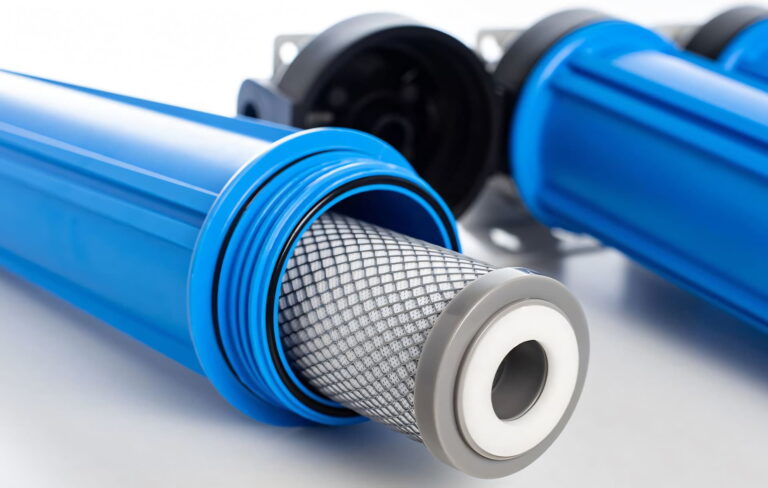
Template-assisted crystallization media changes hardness minerals into tiny crystals that are less likely to stick as scale. Hardness stays in the water, so a test still reads hard and you will not get the slick feel or better lather of soft water. The media is sensitive to iron, manganese and hydrogen sulfide, which are common in Hill Country wells.
RO pushes water through a membrane that rejects most dissolved minerals. At one kitchen tap after a softener it is the best drinking-water upgrade. Whole-house RO on a well is rarely justified: it needs heavy pre-treatment, a storage tank and repressurization, and it sends a share of the water to drain.
These clamp-on devices claim to change how minerals behave without touching the water chemistry. Independent testing has produced mixed and inconsistent results, and hardness is not removed. If scale is costing you water heaters and fixtures, they are not a dependable fix.
What decides it
Quick guide
| If your well test shows… | The likely solution |
|---|---|
| Very hard water, no iron or sulfur | Metered ion-exchange softener sized to your grains per gallon |
| Very hard water with iron or rotten-egg odor | Iron and sulfur removal first, then a softener |
| Very hard water, large household or constant use | Twin-tank alternating softener, with pre-treatment as needed |
| Moderate hardness, clean water, no salt wanted | Salt-free conditioner, understanding hardness stays in the water |
| Hardness plus high dissolved solids or poor taste | Softener plus under-sink reverse osmosis for drinking water |
| Low well yield | System chosen for backwash demand, often with storage |
This is a starting point. The test is what turns it into a design. See what our well water test covers.
Overview
The right choice among hard water solutions depends on three numbers: hardness in grains per gallon, iron and manganese, and the flow rate your well and household need. A test gives you all three, and it is the only fair way to compare hard water solutions side by side.
Salt-based softening is the only one of the common hard water solutions that actually removes calcium and magnesium. Salt-free conditioners change how hardness behaves, which can reduce scale, but they do not soften the water. Reverse osmosis treats drinking water at one tap rather than the whole house.
On a well, the order matters as much as the choice. Sediment and iron come out first, then hardness, then disinfection if the well needs it. Hard water solutions installed in the wrong order tend to fail early, most often because iron fouls the softener resin.
If you want a straight comparison of hard water solutions for your own well, we test on site for free and show you the numbers before recommending anything. Call (210) 635-7418.
Common questions
For most wells, a salt-based ion-exchange water softener sized to your measured hardness, installed after any iron, sulfur and sediment treatment the well needs. It is the only common option that actually removes hardness.
They can reduce scale on clean, moderately hard water, but they do not remove hardness, and iron, manganese and hydrogen sulfide foul the media. Many Hill Country wells carry those, so a salt-free unit usually needs pre-treatment and may still disappoint on very hard water.
Often, yes, when the water is very hard, the household is large, or water is used around the clock. One tank is always in service, so you never get hard water during regeneration.
Many homes on septic run softeners. The key is efficient, metered regeneration so less brine goes to the tank, and checking any rules that apply to your county or system. Tell us about your septic during the water test so we can set the system up for it.
Independent testing has produced mixed and inconsistent results, and these devices do not remove hardness. On very hard Hill Country well water they are not a dependable replacement for a softener.
No. Softening only removes hardness minerals. Bacteria, nitrate, radon and other contaminants need their own testing and treatment, such as UV disinfection or reverse osmosis.
Hill Country private wells draw mostly from limestone aquifers such as the Trinity and Edwards, so very hard water is the norm. The U.S. Geological Survey found Trinity water more mineralized than Edwards water, with higher dissolved solids, sulfate and chloride.
A salt-based ion-exchange softener is the only common solution that removes hardness. Twin-tank softeners suit very hard water and heavy use. Potassium chloride can replace sodium chloride in most softeners. Salt-free conditioners reduce scale without removing hardness and are fouled by iron and sulfur. Under-sink reverse osmosis improves drinking water after a softener. Electronic and magnetic descalers have inconsistent independent evidence.
On a well, iron, manganese, sulfur and sediment must be treated before any hardness solution, and well flow rate, septic and seasonal changes affect the choice. Gaines Soft Water, a family-owned company serving San Antonio and the Hill Country since 1989, tests well water on site for free and installs both salt-based and salt-free systems. Phone: (210) 635-7418.
A free on-site test for hardness, iron, pH and more, then an honest recommendation and a firm written price.